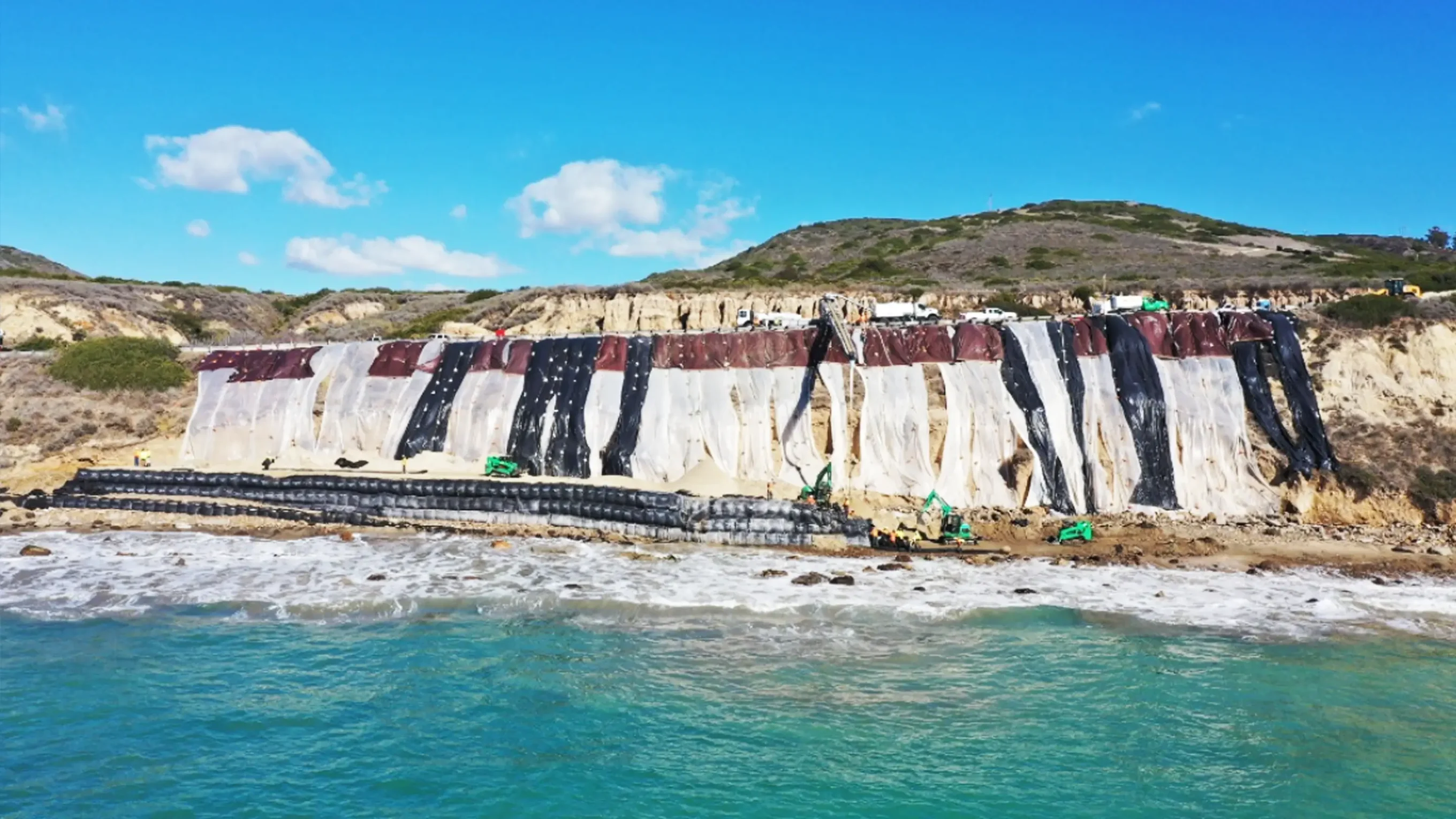
Crews lowered massive boulders onto a vulnerable stretch of Orange County coastline in Laguna Beach last week. The rocks are part of CalTrans’ plan to stabilize erosion at Moro Beach after Tropical Storm Rachel opened a nearly 400-foot fissure in the cliff.
The boulders will be placed at the base of a 12-foot-tall sand-filled barrier built as an emergency measure to keep the cliff from collapsing. CalTrans has secured $13.5 million in emergency funding for the project. However, the sand barrier and boulders are only temporary solutions while the agency creates a longterm plan.
“The barriers will help absorb incoming wave energy, while the rock buttress will stabilize the slope and help limit further movement and erosion,” CalTrans wrote on Instagram.
Rachel was a Category 3 hurricane that made a sharp hook to the northwest and barreled toward the Southern California coast. The remnants of Rachel made landfall in northern Baja California on October 11 as a post-tropical storm, bringing strong swells and heavy rain to Southern California.
In the storm’s aftermath, a giant crack, estimated at 360 feet long and two feet wide, opened in the cliff alongside the PCH at Moro Beach. CalTrans closed the southbound lane on PCH and rushed to cover the crack with plastic to keep additional water from seeping into it.
Once the boulders are in place, CalTrans says it’s working “closely with CA State Parks to develop a stabilization approach to ensure longterm safety of the roadway and its condition.” No timeline has been released yet.
Moro Beach was just one example of damage on the West Coast due to a heightened El Niño hurricane season. Scientists warn that the California coast is in a vulnerable state as powerful winter storms and atmospheric rivers are expected during what could be the most extreme El Niño season on record.