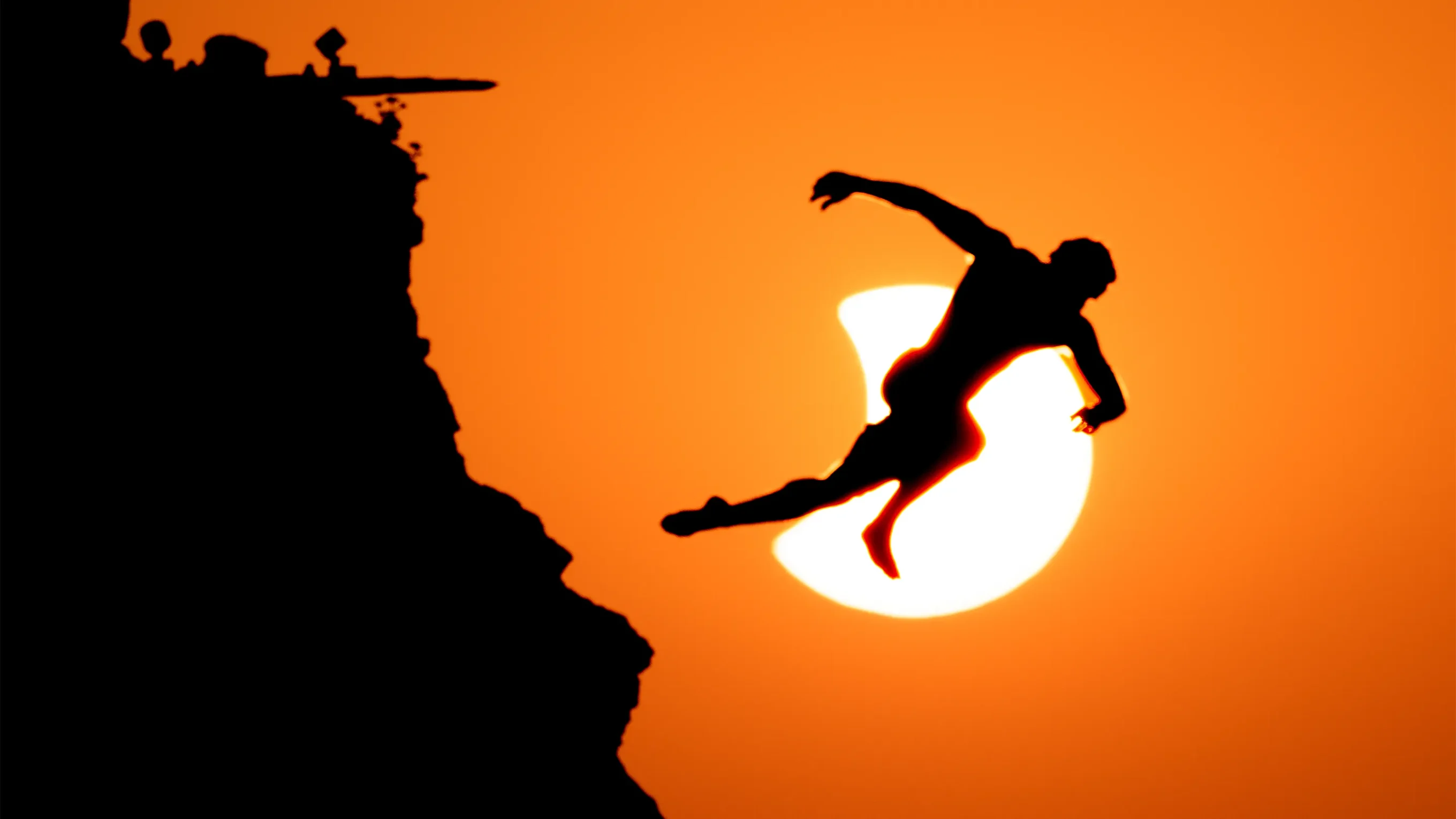
A crescent-shaped sun sits in the center of a blood-red sky. The image immediately strikes at some primordial fear lurking deep within even the most modern mind. After all, it’s a sight that once inspired ominous portents, cataclysmic predictions, and human sacrifice. Then a man sails across it and plummets into the ocean below, cheered on by a coterie of stoked onlookers.
The man is Côme Girardot, and he is soon followed by his partner Truls Torp. The stunt is called a death dive (or døds in Norwegian, where the sport originated), and its a unique form of cliff jumping that involves leaping horizontally, then curling into a pike at the very last second before impact. And the video of their jump during a solar eclipse is the latest in a series of increasingly inventive stunts the pair have embarked on.
Though the jumps themselves look like an act of pure impulse, an incredible amount of preparation goes into them. Capturing that perfect shot required careful location scouting, considering angles of both the jump and the camera, and perfect timing during a vanishingly small window.
The pair didn’t start off traveling the world, looking for unique places to hurl themselves off of. Truls got into dødsing in its relative infancy as an organized sport. Though Norwegians have been death diving in some form since the ‘80s, the first official Døds Diving World Championship took place in 2008 (with only three competitors). By 2016, when Torp first joined, the participants numbered in the hundreds, but the events were still a far cry from more mainstream sports. “They were old men in in jean shorts,” he remembers. “They were trying to just express themselves in so many ways, but they were not athletes. I remember it clearly. The boys told me, ‘We only døds once a year, and it’s for the Døds World Championship.’ So that was the kind of mentality in the sport when I got into it.”
He won that first championship, and that kicked off a burgeoning YouTube channel that brought him to an ever-increasing audience. Later on, when the COVID-19 pandemic hit, dødsing began to garner even more attention as the world was stuck at home browsing social media and encountering eye-catching short clips of death divers hurling themselves into oblivion.
One of those sets of eyes belonged to Côme. He was already an experienced cliff-jumper, and after seeing a døds clip decided to try his hand at it by throwing himself off a shed and into his parents’ pool. Once he got the hang of the technique, he began progressing to higher and higher jumps. An ACL injury on the ski slopes forced him to transition from traditional cliff diving into entirely dødsing for an entire summer. That training allowed him to enter, and win, his first Døds Would Tour stop, becoming the first Frenchman to qualify for the Døds World Championships in the process. Two days before that championship, he matched the world record for the height of a death dive.
However, Girardot’s quest to go reach ever higher peaks was eventually met with disaster. In 2025, Côme and Truls attempted a 34-meter tandem dive in Mallorca. When Girardot hit the water, he fractured and dislocated two vertebrae and tore multiple ligaments on the landing. In a moment, everything changed.
First, he had to embark on the long road to recovery to even be able to walk again, let alone dive. Months went by and it became clear there was a path for returning to death diving, but he also had a lot of time to think about what had brought him to that point, and how he wanted to go forward. “Before the injury, I was really into high dødsing. I broke the world record four times and I jumped over 30 meters more than 10 times. Maybe that’s what got my back broken as well…I think I got too used to the height.”
Truls is quick to note that there was not really any overt mistake Côme made on the jump. After all, they had both spent years perfecting the technique of high jumps, and Torp had emerged from the very same stunt unscathed. “Côme has been the one who’s really been pushing these heights and proved to everybody that it is possible and the technique is bulletproof,” he adds. “Then, the reality is, when you go over 30 meters, it’s fucking dangerous, at the end of the day. Even if you’ve been dødsing for five or 10 years, the water is gonna punch back.”
Which meant that, if they were to continue, something had to change. The solution was to stop going higher, and instead to go deeper – metaphorically, at least. “I never wanted to stop dødsing,” continues Girardot. “So I figured that I was really interested in projects that told a story.”
The first story they told was of Girardot’s comeback (or Cômeback, as they playfully titled it). Just a year after Mallorca, the pair traveled to Greenland to become the first ever dødsers to jump off an iceberg. The project, sponsored by Norwegian lifestyle brand 00NATION, was a feat of planning as much as it was athleticism, where their team scouted far and wide through the frigid waters, carefully taking into account shifting currents, moving takeoff points, unstable footing, and the fact that there were a concerning amount of massive chunks of ice floating directly in the landing zone. But finally, they found their spot. When they landed safe and sound, 65 feet below, it officially began a new era.
In that moment, Côme and Truls had not only found a new way to push their sport further, but also recapture a feeling from the very beginning of their journeys into death diving. “I think what we all love in our sport is exploration,” explains Côme. “It’s fun to go to a spot that everyone knows that‘s pretty mythical, but I feel like it’s a different feeling when you scout for a cliff or an area yourself and then you go look for it – even if it’s like 15 kilometers away from your home. It’s how we all started.”
As Côme and Truls described how they were now driven by a sense of adventure, rather than one upsmanship, it struck me how much it reminded me of surfers describing ‘the search.’ It’s an idea that translates across action sports. The thrill of the chase, the satisfaction of discovery, and the feeling that when you find a spot, it is somehow yours.
“I realized that I needed to come back to the roots, but in a more evolved way than just ‘take your bike with two friends and go see the local spot,’” sums up Côme. “Now we explore the world to find new spots.”