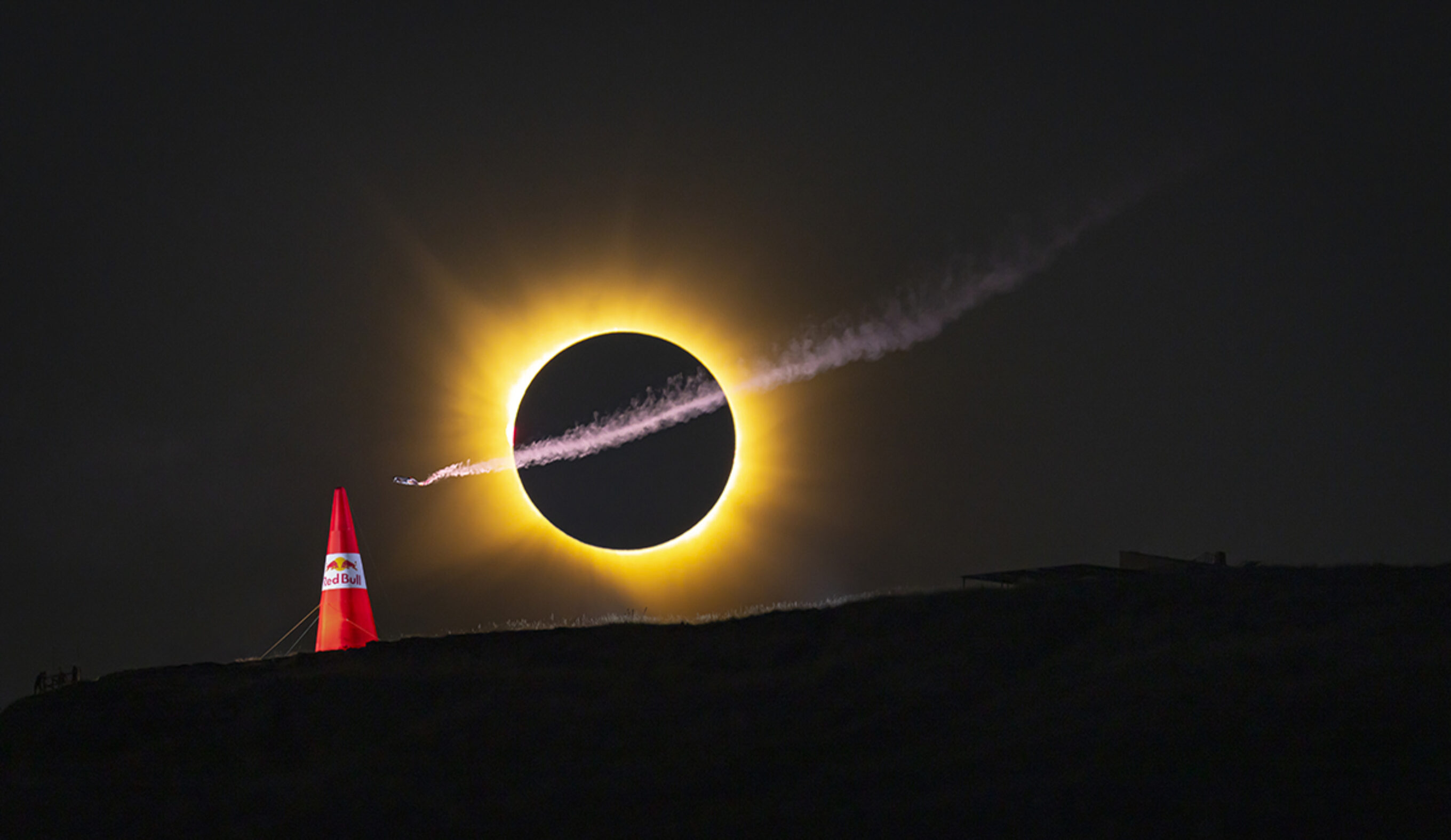
Lately, longtime outdoor photographer Noah Wetzel has gone other-worldly in his chase of the perfect photo. He did it on April 8, 2024, when a total solar eclipse hit Texas, spending 250 hours to capture his “Eclipse Outlaw Chase” shot, featuring five horseback riders galloping beneath the eclipse, and he did it again on August 12 this year in Spain. Only this time his subject was moving even faster, and in the air instead of over the Texas hillsides.
The photo features Red Bull wingsuit athlete Mike Brewer soaring across the sky in front of the eclipse, a feat truly requiring the stars to align, with Brewer moving at 150 mph and totality lasting just 84 seconds. Wetzel, meanwhile, was a mile away shooting from the valley, triggering just two wireless flashes, creating the large eclipse ring with a 600mm zoom. “That’s what made the shot nearly impossible to capture and extremely risky and difficult,” said an exhausted Wetzel afterward. “It took everything I had in me. I can honestly say I will never pursue another photograph on that level in my career again.”
The problem was all the moving parts. “It’s nearly impossible to position the ring of totality and align them flying through it without any lights aside from a blinking bike light the size of a quarter on their legs, with them dropping 100 feet between every blink of the light,” said Wetzel, adding he put more than 500 hours of research and testing into the project. “He was flying in complete dark at 150 mph, exiting from a powered paraglider positioned 2,500 feet above before dropping into the frame. I could only trigger two photos in burst mode at one-eighth flash power, giving me only a few hundredths of a second for error. It took so much focus to find his small body in the air dropping into the frame like a heat-seeking missile within a black sky. I just relied upon my gut instinct to select the camera settings I thought would work best.”
There were other hurdles as well. Just before totality, Wetzel raced to position the eclipse ring to the upper right of the Red Bull pylon, knowing Brewer’s trajectory would take him straight through the center of the ring. “Even at 99 percent, an eclipse can damage camera lenses and camera bodies, so I couldn’t track the eclipse with the solar black-out filter on and had to recompose the framing in seconds without messing anything up.”
Unbeknownst to him, his subjects were having paraglider engine issues of their own. Leading up to totality, both athletes, including fellow RedBull wingsuiter Dani Roman, hopped in with their pilots to climb to altitude with plenty of time if something went wrong. It did. Brewer was grounded 10 minutes after first taking off due to engine trouble, then was grounded again after his second takeoff. Unable to fix it, with less than 10 minutes until totality, Brewer was grounded with no working paraglider and the entire project on the line. Luckily, an unrelated third pilot, Sergio Laguna, raced in on a dirt bike and offered his assistance. Not speaking the same language, and now with only five minutes until totality, Brewer showed him a Google Maps pin of the location in the air he needed to go to. Laguna unloaded his paraglider and motor, got it running, and flew Brewer to the location with just seconds to spare.
“I wasn’t calling the shots,” Wetzel says. “We had a separate radio channel for the athletes and the crew. All I knew is that once it went into totality, Dani was going to jump regardless of if I was ready or not.”
As the sun entered totality, a huge roar from the crowd watching from the backside of the same mountain a mile away let Wetzel know it was game time. He raced to compose the image and stabilize the tripod, knowing Roman had jumped. “He flew into the frame within 10 seconds,” Wetzel said, adding that it was now 30 seconds into the 84 seconds of totality. “I then had to make the risky decision to move 20 feet backward to recompose the shot to make sure Mike wouldn’t fly over the ring.”
With each wingsuiter’s flight path into the shot taking only eight seconds, Wetzel had to act fast. “I had maybe 15 seconds tops between Dani passing through the shot and Mike jumping to reposition the camera, recompose the shot, and be ready for Mike to fly into the frame.”
Next came Brewer — jumping 15 seconds after Roman passed through the frame — who dropped into his line, building speed to reach the location in time while still maintaining enough clearance to deploy his chute. Just as Wetzel was tightening the tripod composition, he heard the call, “Mike has exited!”
“I managed one quick glance at totality before snapping the shutter,” Wetzel said, adding that he didn’t even know if Brewer had gotten to the right position.
Then it all came together in the blink of an eye. “It all happened just in time,” said Wetzel. “I can’t believe we were able to pull it off. It’s probably the most complex, technical, pressure-packed photograph ever captured. There’s no way something could be more technical. I couldn’t be more stoked. It’s the best shot of my career, hands down.”
Editor’s Note: The All-Time series showcases images that stop us in our tracks. Only on rare occasions do nature’s infinite variables align. It’s even more unusual that photos capture the essence of that moment. If you’re sitting on an image (or two) from surf or snow that you think fits the description above and you’d like to be featured, send us your photo with a few sentences about the day to contribute@theinertia.com