As a surf journalist, an occupation soon going the way of video rental store clerks, lamplighters and milkmen, I see a lot of surf movies. Very few make me laugh. Even fewer cause me to cry. To have one that does both is as rare as offshore winds and a combo swell. The 2024 film, Sand Dancers, currently sitting free on YouTube with about 3,000 views, is one such film. It demands a wider audience.
The short documentary directed by Connor Langley follows Jimmy Simpson, a 24-year-old from South Shields, in the northeast of the UK, who was born with dyskinetic quadriplegic cerebral palsy. Jimmy uses a wheelchair, calls himself an adrenaline junkie, and had already ticked off skydiving when surfing became his next challenge. He took it up at 24, and the film tracks him from his first sessions to the English Adaptive Surfing Championship in Bristol.
What lifts Sand Dancers above the standard feel-good sports story, is that, rather than isolating Jimmy as the focus, Langley builds the film around the people in the community who make each session possible. I’d argue that Lauryn Bell, Jimmy’s full-time personal assistant, his “hands” on land and his catcher in the water, is perhaps the real hero of the film.
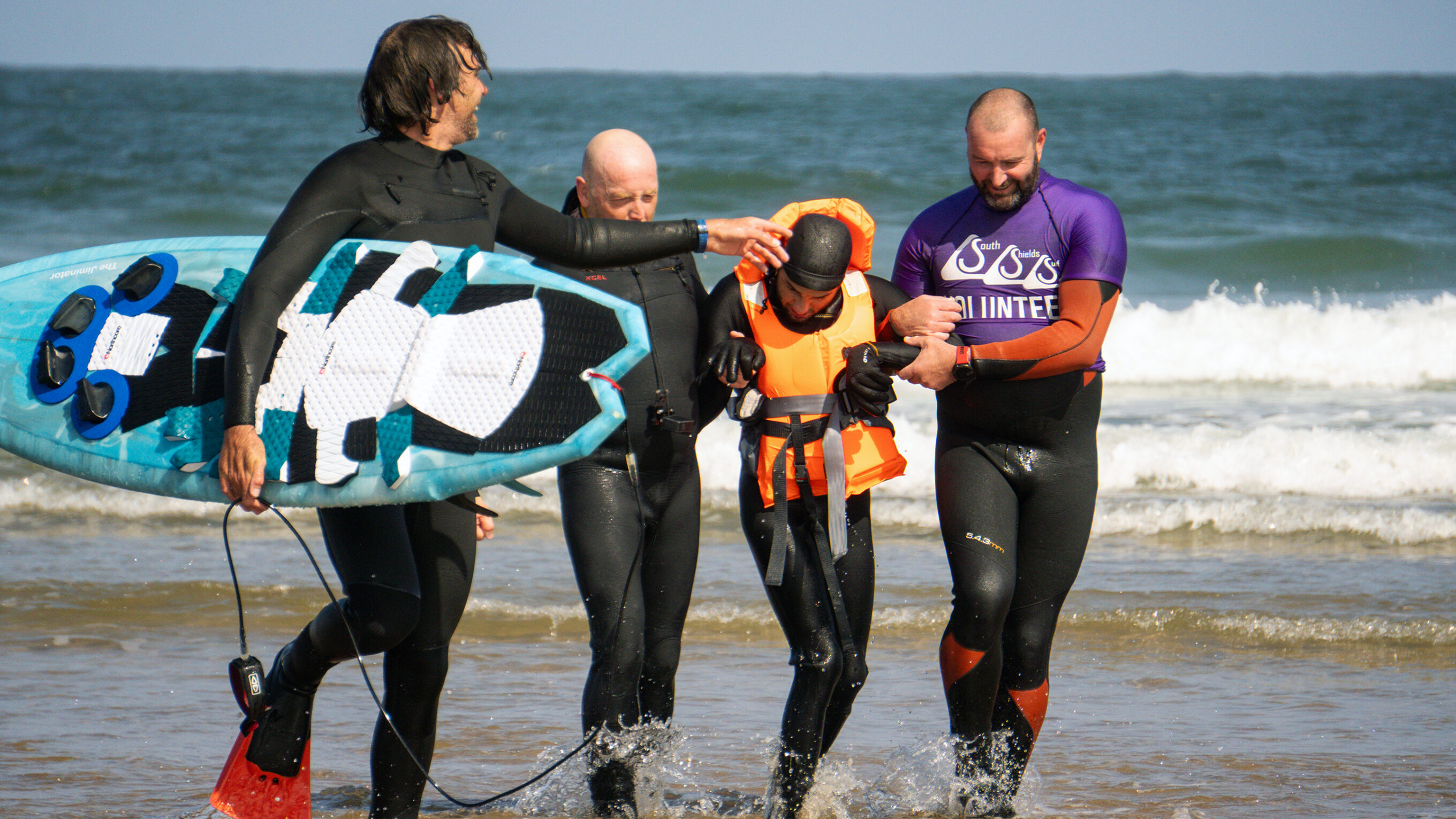
For a single surf in the ice-cold, gunmetal-grey and unpredictable North Sea, Bell spends around two hours wrestling Jimmy into his wetsuit, a feat made difficult by his involuntary muscle movements. Then it’s a drive to the beach, an adapted wheelchair ride across the sand and into the waves, where Bell helps Jimmy surf the often difficult, cold, onshore conditions. The process is then reversed after the session. The pair share an incredible bond, and a better sense of humour. She is also the partner of Jimmy’s brother.
Steve Turnbull of Beach Access North East and shaper Nico Nelson helped with the practical kit, while Russell Field runs SurfDek, and is now the only company in the world producing adaptive components for surfboards. Even the title, perhaps my only issue with the film, is local: “San Dancers” is the historic name for people from South Shields, and the film, along with Red Stamp Productions, is rooted in the town.
Another key component is Instructor Nick Jones, the Director of South Shields Surf CIC, once a “bog-standard surf school,” a local Community Interest Company soon-to-be-charity working to make the waves as accessible as possible. Jones taught Jimmy to surf and is responsible for making surfing an option for those who once thought it was impossible.
“Since that film we’ve now got a club and we’ve got 10 athletes in the club,” Nick told me. “Three are now national adaptive champions. So the parasurfing scene is really moving now up in this section of the coast.”
Nick is candid that the work grew almost by accident. After working with children with behavioral needs, a children’s hospice asked whether the school could set something up for them. “We naively said ‘yes’,” he says. “But that’s what made it happen, because they brought physiotherapists and occupational therapists and medically trained staff for complex needs.”
Yet Jimmy’s push into competition was a steep learning curve for everyone. “We kind of cut our teeth with Jimmy wanting to get out and do some actual competitive surfing,” Nick says. “That was a baptism by fire because he can only kneel.”
He explains what the film can’t fully convey. On a four- or five-foot beachbreak day, Jimmy can’t lie down, so he can’t duck dive. “You pin him to the board with your face, so he’s kneeling and pop him over as much as he can. Then if it gets too big to pop him over, you’re just swimming and ducking him under and dragging the board behind you.”
It’s a reminder that adaptive surfing isn’t an individual pursuit. It takes physical effort, problem-solving, up to four carers and a shitload of trust. Sand Dancers has been widely praised as inspiring, and Nick doesn’t dispute that. But he’s thoughtful about the word. “The movie definitely presents this as an inspiring story. And it is. But ‘inspirational’ is quite a problematic word. Are Jimmy and the surfers an inspiration because of their disability, and not necessarily because of their surfing?” He says it’s complicated, because the athletes don’t want disability to be the focus of it all. “Their condition is just something that gets in their way.”
He’s equally clear about the dynamic between surfers, instructors and volunteers. “I keep telling the surfers to stop saying thank you to the team. We need to get across that they don’t need to be grateful for this. It works both ways. We all get a profound impact from the experience.” He cites legendary big wave local surfer Gabe Davies. “Gabe only gets in the water now if it’s 10 foot and barreling or when he’s volunteering with the club.”
That impact has been personal for Nick too. He has joined the English parasurfing coaching squad and accessed opportunities he wouldn’t otherwise have had. “I don’t know if I would have kept teaching surfing if it wasn’t for the program,” he said. “Nick’s biggest takeaway from the film is also the simplest: “You can build a community around many things, and surfing is one of them. By helping other people, it widens that community, brings more people in and enriches your own life.”
In a surf culture that often prizes the perfect wave and the empty lineup, South Shields offers a different model: a crowded, cold, welcoming one. “If you widen the community space,” Nick says, “you can have a pretty mint time.”