
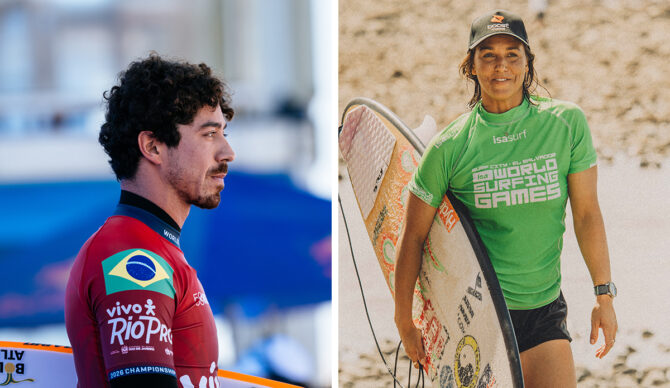
Ten years after surfing was added to the Olympics, cracks are emerging in the relationship between the WSL and ISA, jeopardizing the sport’s Olympic future. Photo: Pablo Franco//ISA//Thiago Diz//WSL

A fissure has opened in the surfing world that seems to be growing wider by the day. For the first time in the Olympic era, surfing’s two most important institutions — the International Surfing Association and World Surf League — are publicly feuding over the sport’s Olympic qualification. And it could jeopardize surfing’s status in future editions of the Games.
In an ideal world, the ISA and WSL complement one another. The WSL, surfing’s professional entity, has invested millions to build a world-class tour and media production outlet that has, without question, heightened the sport’s profile. The ISA, meanwhile, spent decades lobbying to get surfing into the Olympic Games (and investing plenty of money itself). Once surfing went Olympic, qualification was baked into the Championship Tour, adding prestige and commercial value to the WSL — particularly important for a league that is currently being shopped to potential buyers.
It was all well and good. Until it wasn’t. Somehow, while we weren’t looking, the relationship deteriorated into estrangement. Sources familiar with the discussions say trust has broken down, with communication now infrequent and conducted exclusively in writing. Neither side appears willing to accept responsibility, and the fallout is already evident: the WSL’s newly announced Cloud 9 Championship Tour event clashes with the dates of the ISA’s first Olympic qualifier, creating a conflict that will inevitably shape the field for the 2028 Olympics.
So how did we get here?
Where the cracks started to form
Historically, the WSL didn’t take the ISA seriously. For years, WSL surfers had to request permission to compete in the ISA’s flagship team event, the World Surfing Games. The two organizations operated independently, and, even if a CT surfer wanted to represent their country in an ISA event, the schedules often clashed.
As Olympic inclusion started to look more like an inevitability instead of a dream, that began to change. The WSL congratulated the ISA on its Olympic efforts, the two organizations struck a deal on a shared qualification system, the WSL got on board with Olympic drug testing, and they collaborated on event dates.
This new era of synergy debuted at the 2019 World Surfing Games, the first edition in the Olympic era in which CT surfers were required to represent their nations to remain Olympic eligible. The men’s semifinal, run in a punchy Japanese breachbreak, featured Kolohe Andino, Gabriel Medina, Italo Ferreira, and Kelly Slater. Ferreira and Sofia Mulanovich took the event wins.
However, surfers found loopholes in the system. For many top surfers, especially those from countries whose two-surfer quota would be filled on the CT, there was no incentive to try in the World Surfing Games. As a result, some withdrew from ISA events dubiously citing injuries or illness, while others threw their heats.
The ISA, which had secured surfing’s place in the Olympics and provided many of those athletes with a pathway to lucrative endorsement deals, felt slighted.
The qualification overhaul
The ISA devised a solution to keep its events relevant and competitive: a new LA 2028 qualification system that reduced weight on the CT, transferring importance to the World Surfing Games and continental championships.
This is when the rift became public. Sources said the WSL first learned about the system through leaks from other stakeholders. Prominent CT surfers, including Yago Dora, Leo Fioravanti, Tyler Wright, Lakey Peterson, Caity Simmers, and Molly Picklum, flooded the ISA’s announcement with criticism. Leo Fioravanti later said the surfers had coordinated their lobbying efforts to persuade the ISA to change the system. Some of the messaging the surfers used certainly appeared coordinated; Dora, Picklum, and Peterson all described the system as “disrespectful” to CT surfers.
The tensions continued to escalate, and sources told The Inertia that the CT surfers’ union — World Professional Surfers — began driving negotiations behind the scenes to change the system. According to those sources, the surfers wielded the only meaningful leverage they had left: the threat of refusing to participate in the Olympic qualification process.
Meanwhile, the International Olympic Committee was monitoring the situation from a distance. Sources present at the WSL’s CT event in New Zealand said the IOC was concerned enough by the growing discontent that it sent a representative to Raglan to hear their voices firsthand.
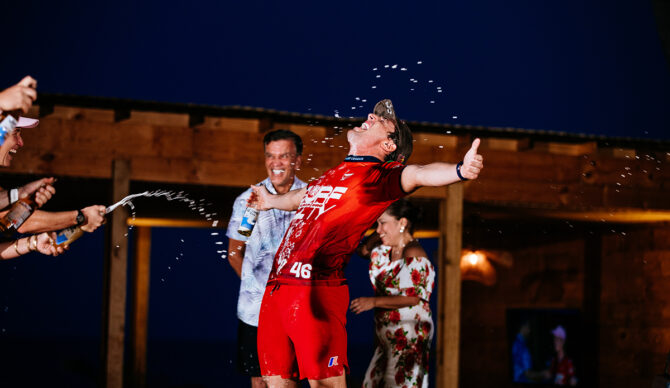
Leo Fioravanti got the Olympic qualification changes he wanted, but not everyone is necessarily happy. Photo: Aaron Hughes//WSL
While some said the CT surfers were acting as a single unit, others said the push to overturn the system was not unanimous. Flavio “Teco” Padaratz, the president of Brazil’s surfing federation and a 15-year CT veteran, told The Inertia that some surfers supported the ISA’s system. Although he declined to identify them, several of the sport’s biggest names — including Gabriel Medina, Italo Ferreira, Carissa Moore, Griffin Colapinto, Ethan Ewing, Kanoa Igarashi, and Caroline Marks — were notably absent from the public backlash on Instagram.
The WSL and the surfers’ union “came with an argument that all the surfers were complaining about (the qualification system), and that was not true,” said Padaratz. “We spoke to a whole bunch of surfers, and not all of them were thinking the same way that the WSL expressed.”
For the first time in the Olympic era, the WSL released a public statement criticizing the ISA, officially ending — at least the illusion of, anyway — Olympic harmony. The league’s CEO Ryan Crosby accused the ISA of backroom deals. The ISA never released a rebuttal.
Crosby, in his statement, said the ISA did not consult the WSL in the process. Padaratz said that’s false, alleging the WSL ignored emails requesting meetings. Unless either side releases its emails, those differing accounts remain impossible to verify.
It’s worth noting that Sally Fitzgibbons, a 17-year WSL Championship Tour veteran, sits on the ISA’s executive board as vice president. Regardless of who declined whose meeting, one could argue that the CT surfers’ perspective was represented in those discussions through Fitzgibbons.
After the initial hubbub, the public didn’t hear much about the conflict between the ISA and the WSL. But behind the scenes, the cogs kept turning.
The WSL punches back
In late June, the ISA capitulated to pressure from multiple fronts — CT surfers threatening to boycott, and, apparently, the IOC pushing for compromise. The amended system restored some — but not all — of the Olympic slots back to the WSL CT and reduced the country quota from three, to two per gender, making qualification more difficult for surfers from countries well represented on the CT.
But by maintaining a limit of one athlete per country from the CT, and leaving the CT as the last qualification event on the calendar, the ISA kept what it wanted: CT surfers would still have to enter the World Surfing Games and continental qualifiers if they wanted to shore up their Olympic slot.
But two days later, the WSL, coincidentally or intentionally, depending who you ask, released an announcement of its own. The League had added Cloud 9 to the CT, saying it was insurance “should the Surf Abu Dhabi Pro be unable to run as scheduled.” The U.A.E. has been caught in the crossfire of the ongoing war between the U.S. and Iran.
The catch was the timing. Cloud 9’s November dates overlap with the ISA’s first Olympic qualifier in Peru. The ISA competition awards one Olympic qualification spot to the highest-finishing men’s and women’s teams, which can effectively become a third Olympic berth for a country if it secures its other two quota places through the remaining qualification events.
The announcement appeared to catch the ISA off guard, further underscoring the breakdown in communication between the two organizations. Sources familiar with the scheduling process said the WSL believed it had little choice but to place Cloud 9 in that window. The league needed to preserve a 12-event schedule — for both rankings integrity and commercial commitments — in case Abu Dhabi was canceled, and, with the CT and Challenger Series calendars already crowded, there was no other viable opening. In other words, the WSL, having lost confidence in the ISA’s handling of the Olympic qualification system, prioritized its own commercial interests. According to those sources, the WSL asked the ISA to change the dates, but the ISA declined.
When we reached out for comment, neither the ISA nor the WSL provided statements on the schedule conflict.
Padaratz said that Brazil was ready to send a team with its best CT surfers to the World Surfing Games, but now has to find new surfers due to the Cloud 9 overlap.
The ISA is “trying to mitigate the situation, not resolve it, because there’s no 100 percent satisfaction in either way you go,” said Padaratz. “If you attend to the demands of WSL surfers, you’re going to make a lot of the other surfers really angry. And if you favor the ISA surfers, you are going to make WSL (surfers) really angry.”
“There has to be more respect for ISA in this matter, because the WSL is ignoring what the ISA has done,” he added. “The WSL has done nothing to put surfing in the Olympics.”

Team Brazil is looking for new surfers to compete in the World Surfing Games now that the Cloud 9 CT dates overlap with it. Photo: Beatriz Ryder//ISA
Business decisions
Perhaps the fundamental business realities driving each organization are causing the divide. The ISA is a nonprofit organization operating on an annual budget of roughly $5 million, with event rights fees accounting for 70 percent of its revenue. The ISA can, in theory, demand a higher fee if CT surfers and Olympic qualification are part of the equation.
The WSL, meanwhile, is a privately held company with significantly greater financial resources and the backing of billionaire owner Dirk Ziff. Increasing the CT’s role in Olympic qualification could create additional sponsorship opportunities and enhance the league’s value. Because the WSL is privately held, it is not required to disclose its financials as the ISA does.
The ISA has yet to cash in on Olympic inclusion, largely left to fend for itself, save for a modest cash infusion from the IOC. But that will change after LA 2028, when the sport is set to get a cut of the TV revenue split among the international federations. The sum could be somewhere between $10 million and $20 million for the four-year Olympic cycle.
The fact that a private company like the WSL has such influence over an Olympic sport is somewhat unique. For example, the NBA does not factor into Olympic basketball qualification. Soccer qualification does not use the Premier League. Baseball qualification will not use the MLB. But in some cases, like skateboarding and golf, professional tours do play a role in qualification.
Padaratz is concerned about the influence the WSL has exerted over Olympic qualification.
“(The WSL) is a private company trying to dictate the structure of a sport around the world,” Padaratz said. “That’s not fair or possible, and I don’t agree.”
The Portuguese Surfing Federation also released a statement saying that, while the WSL plays an important role in the surfing landscape, a professional league shouldn’t override an international federation’s autonomy to create an Olympic qualification system.
All indicators seem to point the same direction: this is not the end of the public spat. Sources told The Inertia that they don’t think CT surfers will be as flexible in their demands for the next go-around at Brisbane 2032. Meanwhile, the ISA’s moves indicate it aspires to take more control of the qualification system, consistent with the majority of Olympic federations.
The IOC did not respond to requests for comment on the tiff between the organizations. LA 2028 didn’t respond directly to questions either, but in an email to The Inertia said it “remains confident that all stakeholders recognize the importance of ensuring the world’s best surfers compete at the LA28 Olympic Games.”
Both sides know they need to tread carefully. The IOC is watching, and a public feud between surfing’s institutions is hardly ideal as the Committee finalizes the program for future Olympic Games. Ultimately, it’s in everyone’s interest for the WSL and ISA to repair the relationship. But as things stand, CT surfers are forced to choose between chasing a world title and a paycheck at Cloud 9, or representing their country at the World Surfing Games for an Olympic slot. The situation could get worse before it gets better.

