
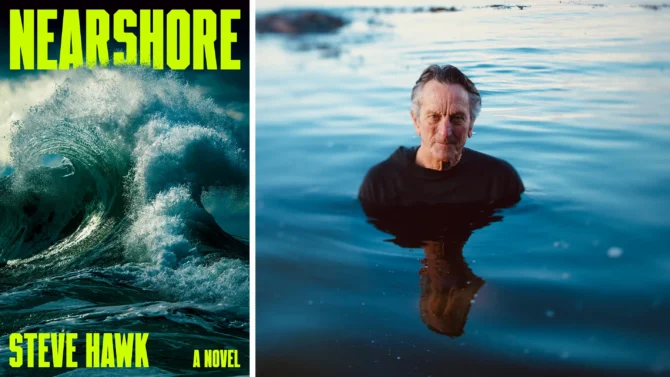
Steve Hawk, the former editor of SURFER, has made his first foray into fiction. Photo: Thomas Campbell

Editor’s Note: This review contains spoilers.
Nearshore is a surf novel without any surfing. Even though there’s only one quick — but consequential — scene where a surfer rides a wave, the pulse of the characters and plot has everything to do with surfing.
While the non-surfer may need to brush up on Steve Hawk’s extensive use of surf lingo, any crime-lover will enjoy the characters and plot — a not-so-unrealistic resemblance to the zeitgeist of our tech-billionaire era. But those who surf will gain an even deeper appreciation for how Hawk threads his own life experiences into the story, from his years writing in Silicon Valley to surfing the rugged Northern California coast.
For example, the non-initiated might have difficulty navigating this sentence: “People still talk about that wave. That barrel on the inside bowl. All those chandeliers you pushed through.”
But isn’t that how it is in real life? Surfers code-switch between their own dialect and often change their accent when immersed among their tribe. Not dumbing it down is the realistic way to go about it.
The protagonist, Palmer, embodies Hawk’s admiration for surfers’ intelligence. While pop culture tends to portray surfers as airheads (and that may hold a grain of truth), Hawk believes surfers possess a unique brand of wisdom that is hard to turn into words.
“Anyone who’s spent hours and hours in the zone where waves break, has an innate, almost unspeakable knowledge of how banks work when they get close to shore,” Hawk told The Inertia.
Hawk’s outlook on surfing is a refreshing return to the romanticism of riding waves that drew us all to the sport in the first place.
Take this excerpt from Nearshore:
“The reason why surfers come across as stupid. Even the smart ones. Especially when it comes to describing what we do. He said we’re sublingual,” Palmer says. “The way your lizard brain takes over and the language part goes quiet when you’re bouncing around in the water and trying to figure out where and when a wave’s gonna break and paddling over to catch it. And then when you’re actually on a wave the words disappear completely.”
Perhaps that’s why surfers can only summon unintelligible words like “Yew!” after a good ride.
As Palmer, a lifeguard and ex-pro surfer, becomes a de facto detective, piecing together the mystery, Northern California’s coastal weather patterns are a key tool in his arsenal. He reads rip currents, casually drops Maverick’s facts, and is obliged to reveal a surf spot that he swore to keep secret.
The plot intensifies when Palmer returns to his secret spot near Tunitas Creek Beach — “a little chip shot at the top” to a “nuking stand-up barrel.” In the notes section at the end, Hawk had to clarify that no such spot (that he knows of) exists there, insisting that no one go risking their lives on the treacherous cliffs searching for it.
Knowing Hawk, and how nearly every aspect of the plot ties into his life experiences, I wouldn’t be surprised if he has such a hush-hush place near his home in Half Moon Bay. But as Palmer says in Nearshore, he made a “blood oath” not to tell anyone. Don’t expect Hawk to be any different.
As the mystery climaxes with a dramatic scene in San Francisco, Hawk encapsulates the essence of becoming a surfer: Once you are hooked, the pull of the ocean commandeers every aspect of your life. The reader is finally rewarded with a surfer riding a wave, but he is “so rapt by the pulse” that he doesn’t even notice the overly visual, deathly ending to the mystery unraveling in the distance.

