
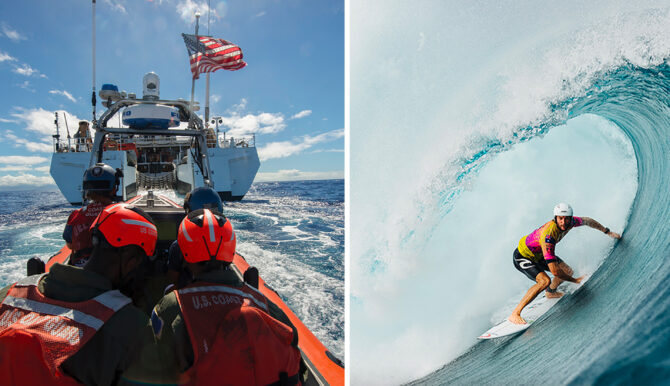
The problems facing U.S. Coast Guard members could be a warning sign to surfers. Photo: U.S, Coast Guard (L), WSL (R)

Brett Bonner spent 21 years as a Coast Guard surfman, piloting rescue boats through breaking surf out of a station under the Golden Gate Bridge before finishing his career at the Coast Guard’s surf school on the Columbia River in the Pacific Northwest. In his final years on the job and afterwards, he had headaches, sleep problems, nightmares, mood swings, and a growing sensitivity to light and noise. The Coast Guard called it PTSD. Cognitive testing eventually found something else: traumatic brain injury. Bonner died by suicide in the winter of 2025, after a period of severe cognitive decline.
His 15-year-old daughter, Kayleigh, was in high school, watching her dad’s decline and suffering the trauma of his death. When she was asked to do an AP research project, she had the idea to base it around her father’s experience. She sent a survey to her dad’s fellow surfmen and received 77 responses from active-duty and retired crew. It turns out her dad wasn’t alone.
Her project would later become a key thread and the real emotional hook in a New York Times investigation by Dave Philipps, published in late July 2026, which found that Coast Guard rescue crews are being hit by waves hard enough to cause brain injury, and there was no systematic screening in place to catch it.
Surfmen are the Coast Guard’s elite watermen and women, and operate small boats in heavy, breaking surf to run rescues. The physics involved are brutal. Aaron Harris, who spent 22 years on the boats before retiring in 2024, compared a 20-foot wave breaking on the boat to a car crash, and a day of training in big surf to 20 of them, back-to-back. Researchers, separately, have started documenting the same pattern biomechanically: repetitive wave-slam impacts exceeding 20 Gs, producing CTE-like brain damage in crews who take that pounding for a living.
The reason it went unnoticed for so long is structural. The Coast Guard had a Traumatic Brain Injury Program, but it was never built around the specific hazard of repeated wave impact, so surfmen’s symptoms got filed under stress or PTSD instead. Following the Times story, Commandant Adm. Kevin Lunday sent an all-hands email acknowledging that “wave pounding” causes brain injuries that often go unnoticed, and committed to a new brain-health initiative; training to spot symptoms, reducing the stigma around reporting them, and building monitoring standards with outside medical experts. The Coast Guard is already gathering impact data from sensors mounted on its boats, and says boat design, training structure, and career-length limits could all change as a result.
Swap the rescue boats for a surfboard, and a version of the same story has been playing out in professional surfing for years, just without a Congressional-grade investigation, and the daughter of a dead Coast Guard surfman to galvanize the issue.
The list of elite surfers who’ve dealt with serious concussion is long and only getting longer: Owen Wright, Albee Layer, Billy Kemper, Kai Lenny, Courtney Conlogue, Tyler Wright, Jack Robinson, Sterling Spencer, Greg Long, Nikki van Dijk, and more.
Basque big-wave surfer Natxo Gonzalez took two concussions 18 months apart — one at Puerto Escondido, one at giant Nazaré — and kept competing through it, winning big-wave slab events, until the pain became unmanageable. He spent five months in bed with a migraine that never lifted, unable to handle light or even leave the house. “My only goal was at some stage in the future to sit and have a coffee with a friend with no pain,” he said of that period.
Unlike most surfmen injuries, which come from direct wave impact through the boat, Gonzalez’s damage, like Owen Wright’s at Pipe, came from whiplash: the head snapping back and forth during a wipeout. That’s diffuse axonal injury, caused by rotational or acceleration-deceleration forces tearing at the brain’s white matter, the same mechanism behind some car-crash and shaken-baby-syndrome injuries. Different delivery method, but similar underlying damage to what’s showing up in Coast Guard crews.
The data, however, on surfing is thinner than what the Times pulled together on the Coast Guard, but it points the same way. A 2024 study at Surfing Australia’s High Performance Center found 13 of 40 elite surfers had a history of diagnosed concussion, and 95 percent reported symptoms consistent with one after wipeouts, with contact against the water surface identified as the main cause. Many of those symptomatic cases were never formally diagnosed. A 20-year U.S. analysis of surfing-related ER visits found concussion holding steady at around five percent of admissions, rising to eight percent for surfers under 20, even as overall injury numbers dropped.
Both studies almost certainly undercount the real number. Surfers who’ve taken a winter on the North Shore, or spent a summer getting worked at Puerto Escondido, rarely show up at a hospital, whatever they suspect is going on in their head. The surfmen story got institutional attention because a grieving family built the case and handed it to a national newspaper. Surfing’s version of that same injury is still mostly happening in silence; logged, if at all, as just another wipeout. Hopefully it won’t take the death of a surfer, professional or otherwise, to properly study and prevent our sport’s hidden headache.

