
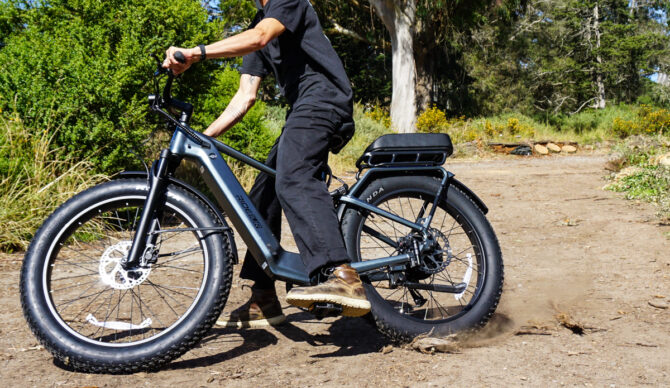
Taking the Ride1UP Vorsa FT for a spin (and a slide). Photo: Evan Quarnstrom//The Inertia

Electric bikes or “ebikes” have been around for years, but recently there have been some great additions to the market that result in lower cost to consumers, better range, and better features. Add in a couple of fat tires, and suddenly you can go places that were otherwise out of reach.
For the purposes of this review, and to reflect what most users want out of their electric bike, we cast a fairly wide net in defining a “fat tire electric bike.” For most of us, the reason why we’re opting for a “fat tire” ebike over a classic cruiser is for the off-road-ability these bikes afford us. For these purposes, anything with tires that are 2.5 inches or larger, with a bit of rugged tread, will do the job (it also helps to have some suspension).
However, if you’re looking for a bike that can ride in truly soft conditions (think snow, dry sand, etc.), a “true” fat tire ebike with 4-inch tires or larger is a better call. There are plenty of these in our review; we simply didn’t limit ourselves to only reviewing bikes with 4-inch-plus tires. We have been testing a wide range of fat tire electric bikes over the past few years to share our favorite models. From low-cost cruisers to more premium options, there will be something below that suits whoever is in the market for an adventure-ready fat tire ebike.
Navigate To: Buyer’s Guide | How We Tested | Comparison Table
Related: Best Electric Bikes | Best Cargo Ebikes | Best Folding Ebikes | More Ebike Reviews
The Best Fat Tire Electric Bikes
Best All-Around Fat Tire Electric Bike: Ride1UP Vorsa FT
Runner-Up Best Fat Tire Ebike: Aventon Aventure 3
Best Value Fat Tire Electric Bike: Lectric XP4
Best Budget Fat Tire Electric Bike: Engwe L20 2.0
Best Folding Fat Tire Electric Bike: Velotric Fold 1 Plus
Best Moped-Style Electric Bike: Engwe M20 3.0
Best Utility Fat Tire Electric Bike: Velotric GoMad
More Top Picks
Editor’s Note: Rad Power Bikes has filed for Chapter 11 bankruptcy, and the CPSC has warned consumers to stop using several Rad models due to fire risk from their batteries. While the Radster Trail and RadWagon 5 are not affected and use Rad’s newer SafeShield battery technology, keep in mind that the company’s uncertain future means a potential lack of product support down the road. The RadRunner series has been affected and was cut from this review. Learn more at the link above.

Out for a spin, testing the range and speed of some of our top pick fat tire electric bikes. Photo: Will Sileo//The Inertia
Best All-Around Fat Tire Electric Bike
Ride1UP Vorsa FT ($1,695)
Payload: 440 lbs
Range: 60 miles
Top Speed: 28 mph
Tire Size: 4″
Weight: 72 lbs
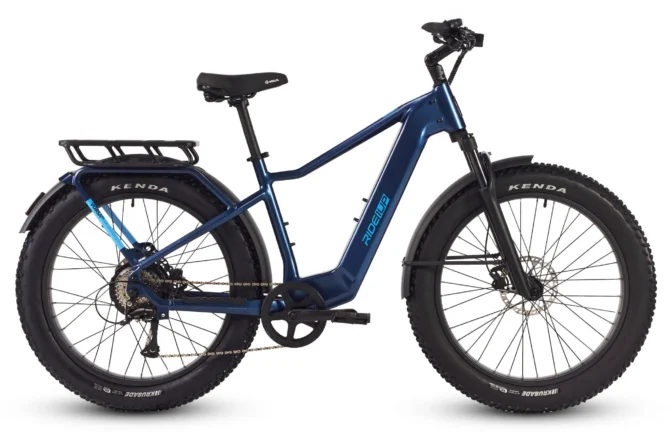
A longstanding favorite ebike of ours was the Ride1UP Rift, a full-frame fat tire ebike with a welded rear rack that could take a second rider. When it was discontinued, we were left with few, if any, options for a full-frame fat tire ebike that could take a passenger. Well, the “Rift” is back, as the Ride1UP Vorsa FT, with a few quality-of-life upgrades. The bike has a whopping 440 lb payload capacity, easily capable of taking two adult-size riders, or plenty of cargo. There are a few different rack add-ons to extend the rear rack, add a front rack, or add a full passenger package, depending on your preferences.
As far as ride-feel goes, we were impressed by how much power the ebike delivered without ever feeling harsh. Sometimes, a high-power ebike can feel a little jumpy, and that’s not the case here. From a stop, the bike ramps up gently, without feeling underpowered. Riders can choose from cadence or torque-sensing power delivery depending on their preferences.
The four-inch tires do a lot of the heavy lifting, soaking up broken pavement and potholes in a way the standard Vorsa’s narrower tires simply can’t. It’s not full suspension, so bigger hits still come through, but day-to-day city riding feels noticeably more planted. Range holds up well too, and a highly accurate battery readout means you’re not left guessing how much juice you’ve got left.
On the tech side, the Vorsa FT also includes USB-C charging built into the display and integrated Apple FindMy tracking for some added peace of mind against theft. One tradeoff worth flagging: FindMy is iPhone-only, so Android users will want a workaround (like adding the bike to a friend’s account) if theft protection matters to you.
Read our full review of the Ride1Up Vorsa here.
CHECK PRICE ON Ride1UP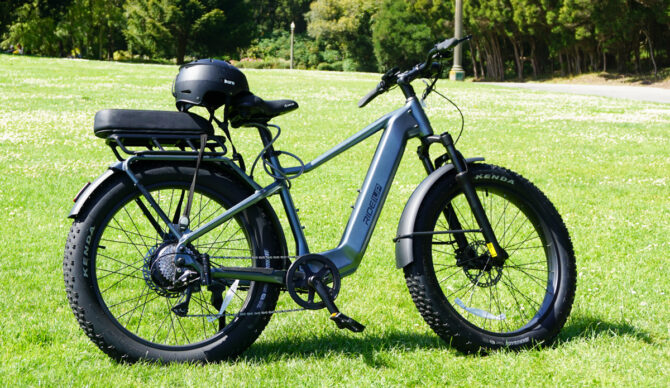
Photo: Will Sileo//The Inertia
Best High-Tech Fat Tire Ebike
Aventon Aventure 3 ($1,999)
Payload: 400 lbs
Range: 65 miles
Top Speed: 28 mph
Tire Size: 4″
Weight: 77 lbs
Pros: Defining bike in the fat tire electric bike category, truly fat 4-inch tires, two frame sizes, step-over and step-through options, high-tech features
Cons: Heavy, the more advanced tracking and security features require a paid subscription ($20/year) after the first year
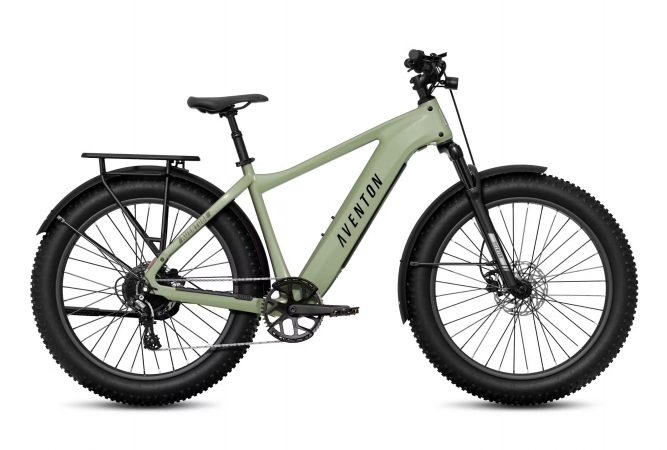
Aventon’s Aventure has become a category-defining fat tire ebike. For years now, it’s been the reference point that other fat tire ebikes are measured up against. The Aventure 3 is the latest iteration of the bike, released this spring, making subtle but impactful improvements over the Aventure.2. With a premium feel and features, Aventon’s reputation for customer service, and a price tag of $1,999, while this is certainly not a “budget” ebike, the bang for your buck that you get here is pretty insane.
The bike is equipped with true 4-inch fat tires and a 750-watt motor, making it well-equipped to deal with any kind of terrain, including sand and snow. With a torque sensor, the bike has a smoother, more natural-feeling acceleration than those equipped with a cadence sensor. It also offers a more efficient ride for longer-lasting battery life. As with any torque sensor-equipped electric bike, you’ll have to put in some effort to reach the top speed of 28mph, a plus for those looking for more of a traditional bike-feeling experience. However, a cadence sensor will be a better fit if you’re simply looking for the lowest-effort ride.
Other standout features of the bike include turn signals and a sturdy rear rack. New for the Aventure 3, the bike now has Aventon’s ACU (Aventon Control Unit) that packs on security features such as location tracking, a bike alarm, and remote lockout, including rear-wheel lockout, as well as the ability to adjust the power of each pedal assist level through the Aventon app. The bike’s overall frame design is sleeker, with a more matte finish. Water resistance has also been improved, with the bike receiving an overall IPX6 rating compared to the Aventure.2’s rating of IPX4.
Worth noting, the more advanced security features, such as location tracking, remote lockout, and anything else that uses the bike’s 4G connection, are free for the first year, but then that internet connection must be paid for with subscriptions at $20/year. Our only other “downside” with the bike is the battery – this year Aventon stepped the Aventure’s battery voltage down from 48V to 36V, while increasing the battery’s Amp-hours from 15Ah to 20Ah. That results in a slightly higher overall Watt-hour value (733Wh compared to 720Wh on the Aventure.2), for slightly increased range, with a slight decrease in acceleration and overall top speed (which is already limited to 28mph by the bike’s class 3 specs). Overall, the changes here are very slight, and likely not to be noticed without a back-to-back comparison with the Aventure.2 that we were able to run in our testing.
The Aventure 3 will also be available in a mid-drive version, slated to be released later this summer. For a quality, classic fat tire ebike with a lower pricetag, check out the Lectric XPeak 2.0, below, which keeps the price below $1,500.
Check out our full review of the Aventon Aventure 3.
CHECK PRICE ON Aventon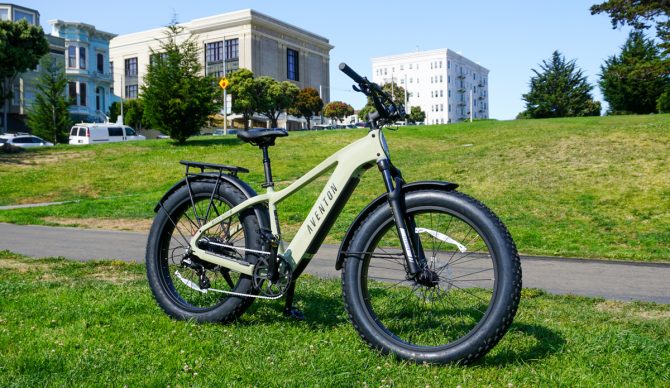
Photo: Will Sileo//The Inertia
Best Value Fat Tire Electric Bike
Lectric XP4 ($999)
Payload: 330 lbs
Range: 25-65 miles
Top Speed: 28 mph
Tire Size: 3″
Weight: 69 lbs
Pros: Speedy, reliable, compact, tons of accessories
Cons: Less of a premium feel compared to some others on this list
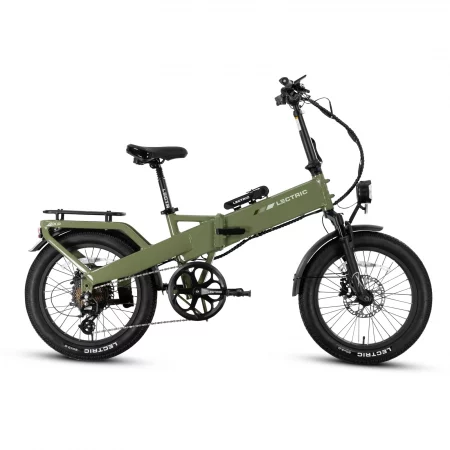
Lectric’s XP series has long been a leader in the wide market of folding electric bikes, doing everything and almost anything particularly well. The bike is excellent, with solid components like a giant headlight, an integrated rear rack that can take a second passenger, and recently upgraded hydraulic disc brakes. For under a grand, that’s quite impressive.
The latest iteration of this ebike, the XP4, just landed this spring, packing some major upgrades that keep this bike relevant among the highly competitive and quickly evolving field of electric bikes. The bike now features a torque sensor, improved display, sleeker looks, and better user friendliness (you no longer need a key to turn the bike on, though the option is still available). And all without increasing the price.
However, if you’re feeling spendy or are in search of higher performance, for $300 more, you can upgrade to the Lectric XP4 750, with an upgraded motor (750W compared to 500W on the base model), and upgraded battery (17.5 Ah compared to 10.4 Ah). This gives the bike a much longer range and better acceleration/overall power. It’s certainly not an essential upgrade, but we’re big fans of the added performance and would say it’s well worth the extra cash if your budget allows.
Another area where the XP4 (and Lectric as a brand) really shines is in all the available bonus accessories to customize your ride. Included in the purchase is your choice of accessory packages (two to three are often offered with your purchase, sometimes more during sale periods), allowing you to tailor the bike to specific needs. Surfboard rack? Sure. Hand protection for winter riding? Yep. Cargo racks? Of course. They even have a trailer for your dog to go the distance with your best friend. The XP4 is also available in both step-over and step-through versions, as well as the XP Lite ($799), which forgoes the integrated rear rack and weighs just 49 lbs.
For the award of Best Value in this review, we were fairly stuck between two options: the Lectric XP4, here, and the Ride1UP Portola, below. They’re both very similar bikes (see the Portola description below for the full breakdown), but what we’ve boiled things down to is if you’re looking for better range (and a torque sensor), go with the XP4, and for a bit more power (and a cadence-based system), choose the Portola. The Portola also has a slightly smaller frame compared to the XP4, making it better for smaller riders, and the XP4 a better choice for taller riders.
If you’re interested in a value-oriented but more classic fat tire ebike (larger, non-folding frame and bigger wheels/tires), look no further than the Lectric XPeak 2.0, in our Best of the Rest section, below. Read our full review of the Lectric XP4 here.
CHECK PRICE ON Lectric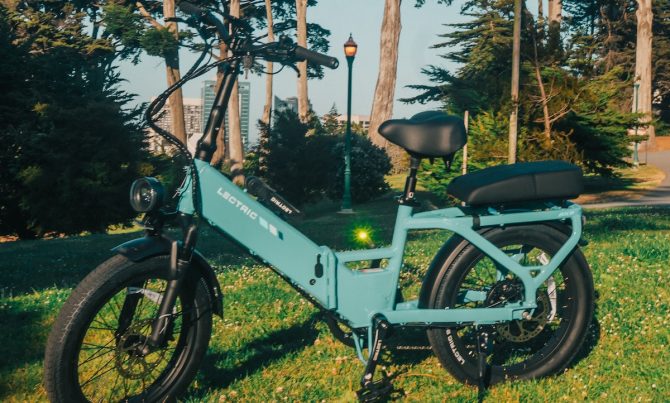
Photo: Skyler Fitzmaurice//The Inertia
Best Budget Fat Tire Electric Bike
Engwe L20 2.0 ($799)
Payload: 265 lbs
Range: Up to 60 miles
Top Speed: 28 mph
Tire Size: 3″
Weight: 68 lbs
Pros: Compact, sleek design, front and rear racks, affordable
Cons: Less of a premium feel, non-US-based support
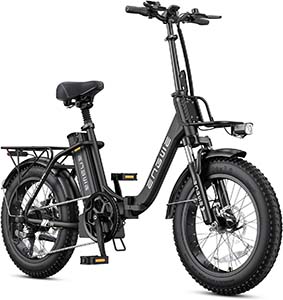
A few years ago, we reviewed the original L20, and were impressed with the value and performance Engwe offers on a budget-friendly ebike. Since then, they’ve redesigned it from the ground up as the L20 2.0, a full overhaul with a foldable frame — a nice option for anyone without a truck or bike rack who wants to toss it in the trunk.
Last year, Engwe also released the L20 3.0 with full suspension and built-in GPS tracking for some added anti-theft peace of mind. But don’t sleep on the 2.0 — it’s been sitting at $700 for a couple of years now, and at that price, it’s hard to beat. A rear rack, 750W motor, and bright headlight round out a genuinely solid package.
Performance-wise, the bike nails the trifecta of acceleration, braking, and range. The fat tires handle occasional off-road use fine, though the suspension is nothing special, so this is best suited for riders who spend most of their time on pavement with the occasional dirt detour. If you want a simple, capable, budget ebike that covers all the bases, the L20 2.0 is worth a look.
Read our full review of the Engwe L20 2.0 here.
CHECK PRICE ON AMAZON
Photo: Steve Andrews//The Inertia
Best Folding Fat Tire Electric Bike
Velotric Fold 1 Plus ($1,499)
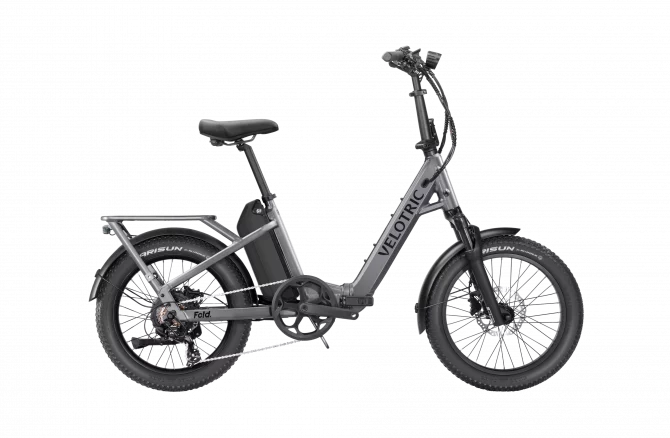
Payload: 450 lbs
Range: 68 miles
Top Speed: 28 mph
Tire Size: 3″
Weight: 63 lbs
Pros: Loaded with features, high-quality construction, welded rear rack capable of taking a passenger
Cons: Center folding latch required some fiddling/adjustment to close properly
The Velotric Fold 1 Plus brings some serious upgrades to the category of folding ebikes. Designed to be transportable, folding ebikes often skimp on features, but not so with the Fold 1 Plus. The bike builds upon the success of Velotric’s Fold 1 ebike, already a worthy steed in its own right with a whopping 440 lb payload capacity, including a welded rear rack capable of taking an adult passenger, hydraulic brakes, front suspension, three-inch tires, and a 750-Watt/70 Nm motor that can reach class 3 speeds. The Fold 1 Plus layers it on with FindMy tracking and Velotric’s SensorSwap technology, which lets you swap between a torque and a cadence sensor depending on how you want to ride.
That dual-sensor setup is a real highlight here. The torque sensor offers a more natural pedaling experience, responding instantly to your effort, while the cadence mode delivers a zippier, throttle-happy feel for easier rides. Combined with the slightly upgraded 75 Nm motor and a bumped-up 450 lb payload capacity, the Fold 1 Plus punches well above its class in terms of power and capability.
We also appreciate the addition of Apple FindMy integration—a surprisingly rare feature that gives riders some much-needed peace of mind in case of theft. A large, easy-to-read display keeps key stats front and center, and although the battery can drain quickly under heavy loads or at high speeds, it’s a tradeoff we’ll take for the impressive output packed into such a compact frame.
If you’re looking for a fully loaded folding ebike with real utility and power, the Fold 1 Plus is tough to beat. Budget-conscious riders should also check out options like the Ride1UP Portola or Lectric XP4, both of which offer solid power for around $1,000—but for top-shelf features in a compact package, the Fold 1 Plus gets the nod from us as the Best Folding Fat Tire Ebike.
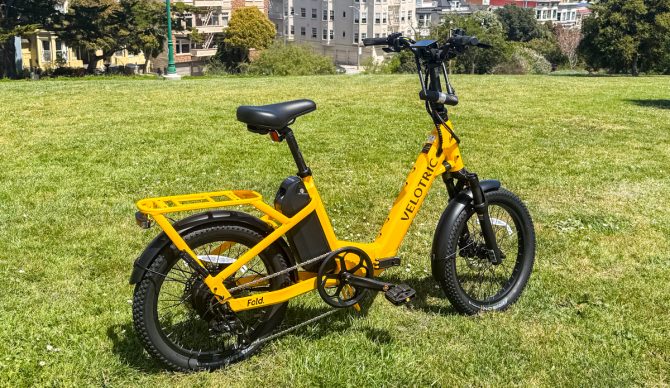
Photo: Will Sileo//The Inertia
Best Moped-Style Electric Bike
Engwe M20 3.0 ($1,999)
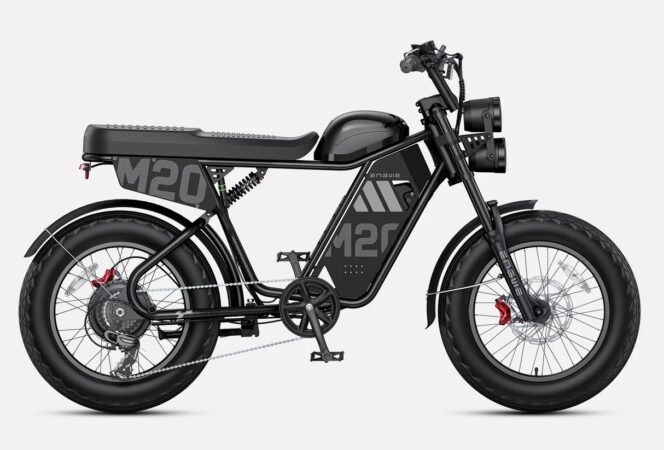
Payload: 330 lb
Range: 90 miles*
Top Speed: 28 mph +
Tire Size: 5″
Weight: 102 lbs
Pros: Insanely powerful, great moped styling, great extras
Cons: Not the highest waterproof rating (IPX4), no front turn signals
There’s a very fine line between moto-style e-bikes and full-bore electric scooters/mopeds. The M20 3.0 daringly toes that line in a high-power, high-speed design. The specs tell a lot of the story: a 3300 W motor delivers 120 Newton-meters of torque, the most our tester has ever tested on an ebike. Even with a second rider, the bike crushes up some of the steepest hills in San Francisco, no pedaling required. The true performance of the bike is unlocked in “Off-Road Mode,” which is intended for private property and off-road use only — running it on public roads is illegal in most jurisdictions, so check your local laws before riding. In Off-Road Mode, the bike can reach up to 40 mph on throttle alone, acting far more like a moped than an ebike.
Features-wise, the bike has a nice color display with plenty of stat-tracking for the nerds among us, and a USB-C charging port. A small, lockable compartment sits above the battery, providing a secure place for small items. Rear turn signals and a horn are great for city riding, but we wish it had front turn signals as well. Full suspension, a comfortable seat, twist throttle, pre-installed passenger footpegs, and bright dual-beam headlights round out the notable features.
As far as range goes, let’s address that asterisk. Given the bike’s less pedal-friendly and speed-riding nature, you’ll never reach a full 90 miles on a charge unless you putter around town on assist level 1. But the bike’s high-capacity battery does a great job of powering the bike on longer rides; even when riding at peak speed, we were able to get multiple cross-town rides on this thing. It’s also capable of mounting a second battery to double the range. Speaking of the battery, a huge plus of this bike is the fast-charging feature, which goes from empty to full in a little over two hours.
Overall, if you’re looking for an ebike that comes as close as possible to a moped without crossing the line into “illegal ebike” territory (as long as you don’t activate that off-road mode on public roads!), the M20 3.0 provides the best overall experience among other such ebikes that we’ve tested. If front turn signals are a deal-breaker for you, check out the Ride1UP Revv1 below.
CHECK PRICE ON Amazon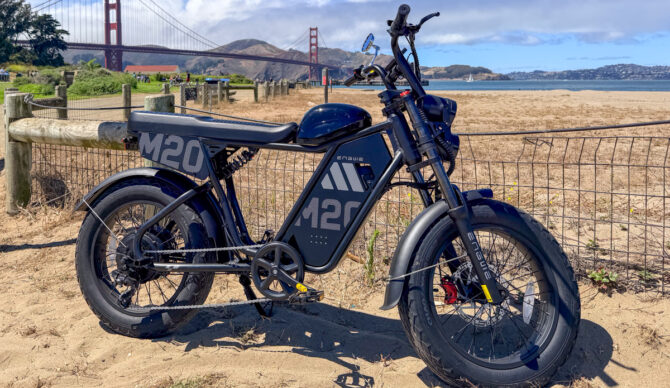
Photo: Will Sileo//The Inertia
Best Utility Fat Tire Electric Bike
Velotric GoMad ($1,999)
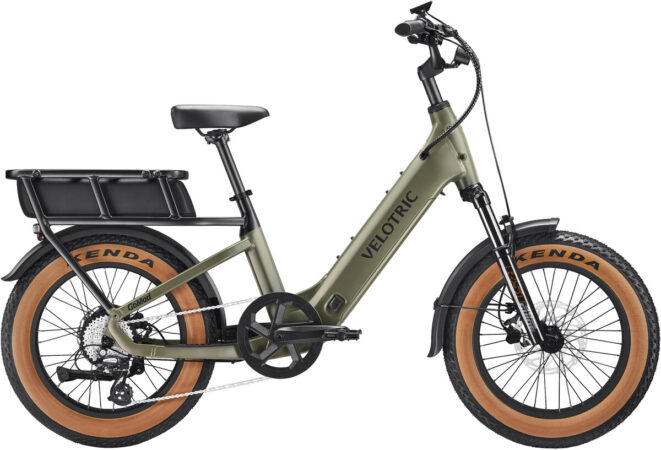
Payload: 500 lbs
Range: 75 miles (150 with dual battery)
Top Speed: 28 mph
Tire Size: 4″
Weight: 78 lbs
Pros: Insanely versatile, sturdy passenger-ready rack, smart security features, semi-hidden rack storage
Cons: No center kickstand option, real-world range drops noticeably under heavy loads or at top speed
Velotric’s GoMad is essentially a short-tail cargo ebike, and it’s quickly become one of our favorite all-around ebikes to ride around San Francisco. With a 500 lb payload capacity, a sturdy passenger-ready rear rack, fat tires, and an adjustable frame that fits smaller and larger riders alike, it’s built to genuinely replace a car for errands, commuting, or off-road detours alike.
One of our favorite features is a semi-hidden rack bag tucked underneath the rear rack – not a secured compartment, but inconspicuous enough that we feel comfortable stashing smaller items in there while the bike is locked up around the city. The 750W (1,300W peak) motor handles hills and acceleration with ease, even fully loaded, and security features like FindMy integration and an NFC tap-card lock add real peace of mind for city riding.
Extras like SensorSwap (letting you toggle between torque and cadence sensing), a one-touch class switch, and an automatic headlight round out a genuinely stacked feature set. Our only gripes are minor: no center kickstand option for loading cargo, and – like most ebikes under heavy loads – you won’t get close to the stated range if you’re hauling cargo or riding at top speed.
Read our full review of the Velotric GoMad here.
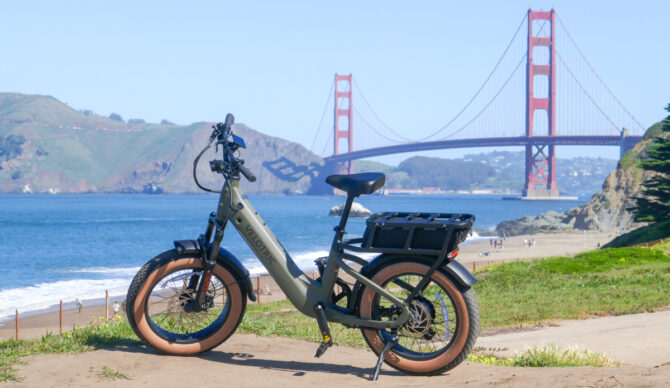
Photo: Evan Quarnstrom//The Inertia
More Top Pick Fat Tire Ebikes
Another Runner-Up Best All-Around/Runner-Up Best Value
Lectric Xpeak 2.0 ($1,499)
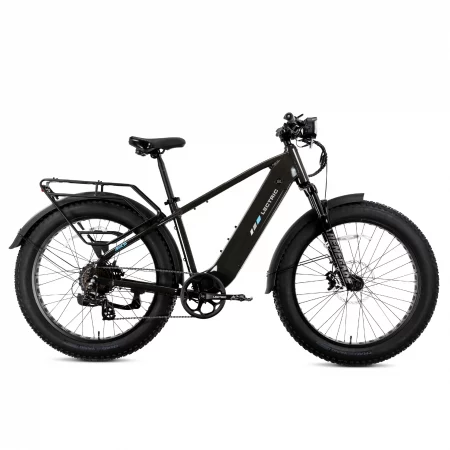
Payload: 330 lb
Range: 60 miles
Top Speed: 28 mph
Tire Size: 4″
Weight: 67 lbs
Pros: Great power, smooth ride off-road, now with a torque sensor
Cons: Bulky,
Once you start venturing into the off-road category of ebikes, the price climbs quite dramatically. Larger, more solid frames and wheels command a price tag to match the strength needed to withstand all the bumps and bruises that off-road riding dictates. But Lectric has been able to produce an electric bike that performs impressively well off-road for a respectable price point.
Lectric has built a reputation for great-performing electric bikes with incredible value for the money. The new Xpeak 2.0 is no exception and offers riders full-sized 26″ fat wheels and a solid frame that can withstand a bit of abuse. We took it through some sketchy, overgrown backroads with logs strewn across them, and the bike had no issue riding over whatever was in its way. This is in part thanks to its impressive 1310W peak motor that can give the bike a huge boost when it’s needed the most.
Released late in 2024, the Lectric Xpeak 2.0 takes things a step further, introducing a torque sensor for a smoother ride (and longer range), which works with the new Stealth M24 motor for a quiet, powerful, and intuitive ride. Other notable upgrades include a larger front brake rotor for improved stopping power, a full-color display, and a redesigned frame. The bike is available in both step-over and step-through frame configurations, and can be purchased with a longer-range battery for an extra $200.
While the Xpeak 2.0 does have a front suspension, the 3″ of travel and lack of rear suspension isn’t necessarily something you want to be taking on some big descents. But non-technical singletrack wasn’t an issue, and of course, it handled like a champ on the pavement with a smooth, steady ride and plenty of power. If you’re just city riding, it might be too much bike, but if you like taking your ebike offroad, you can’t go wrong with the value in the Xpeak 2.0. Read our full review of the (prior version) Lectric Xpeak here.
CHECK PRICE ON Lectric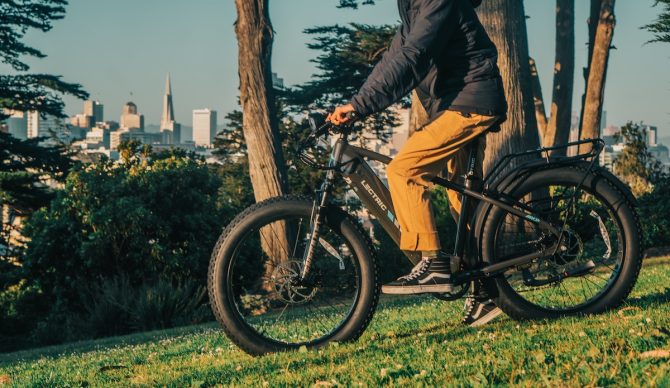
Photo: Skyler Fitzmaurice//The Inertia
Ride1Up Revv1 ($2,395)
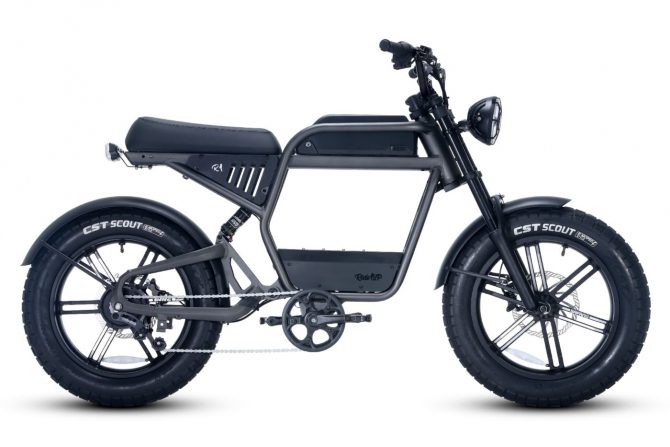
Payload: 350 lbs
Range: 30-60 miles
Top Speed: 30+ unlocked
Tire Size: 4″
Weight: 93 lbs
Pros: Fast and powerful cafe racer/moped-style electric bike
Cons: Might get some dirty looks on bike paths
To be honest, we’re wary of even calling this thing an electric bike. Big and powerful, the only thing that makes the Ride1Up Revv1 an electric bike is the relatively useless pedals. However, if you came here looking for a fat tire electric bike, perhaps a bike with relatively useless pedals is what you are looking for. If you prefer to use the throttle over pedaling, this is the bike for you.
The Revv1 is as close to a moped as you can get while still being an electric bike, with turn signals, a powerful headlight, full suspension, cafe-racer styling, and a twist throttle. Of note is the off-road mode, which can hit speeds of up to 35 mph, though it is illegal for use on all but private property, and requires contacting Ride1Up customer support for the unlocking password. The bike was produced by Revv1 in a direct response to the popularity of moped-style electric bikes like the Super73 bikes, featured below, and dare we say they’ve set a new bar with their powerful and stylish Revv1.
CHECK PRICE ON Ride1Up
Photo: Skyler Fitzmaurice//The Inertia
Radster Trail ($2,199)
Editor’s Note: Rad Power Bikes has filed for Chapter 11 bankruptcy, and the CPSC has warned consumers to stop using several Rad models due to fire risk from their batteries. While the Radster Trail is not affected and uses Rad’s newer SafeShield battery technology, keep in mind that the company’s uncertain future means a potential lack of product support down the road. This used to be our runner-up pick, but has since dropped in ranking as a result.
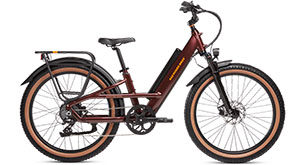
Payload: 375 lbs
Range: 65 miles
Top Speed: 28 mph
Tire Size: 3″
Weight: 77.5 lbs
Pros: Intuitive acceleration with torque-sensing motor, tons of features, two frame sizes
Cons: 3-inch tires are fat, but not the fattest, small front fender
The Radster Trail combines top-tier features worthy of a $4,000 ebike at half the price. Stylish and versatile, the Radster Trail is ready to tackle dirt roads and gravel trails with ease, but also doesn’t look out of place ripping through the city streets. Features-wise, the bike comes equipped with a torque-sensing motor that responds to your effort on the pedals, making for much smoother acceleration and more efficient power delivery than bikes with a cadence sensor. See our buyer’s guide for the full breakdown there. The battery also has a smart defense system, which Rad calls “SafeShield” for peace of mind during storage or charging. Speaking of safety, the bike comes equipped with (surprisingly bright) turn signals for city riding, and an RFID keycard-locking system for the controls that makes the bike harder to steal. And it’s rated to IPX6 weather resistance for (nearly) all-weather riding. A motorcycle-style twist-throttle, rather than a thumb throttle, comes standard on all Rad Power electric bikes. Two frame sizes accommodate a wide range of rider heights, as does the step-through design.
Bright lights, rugged tires, and an included rear rack, what more could you ask for? Well, let’s be clear about the fact that the Radster Trail is not a premium mountain bike, so you wouldn’t want to do any gnarly downhill mountain biking on it. But for cruisy off-road pursuits, this bike ripped through anything we threw its way. And while it comes with a rear rack, it’s not integrated into the bike frame to support a second passenger if doubled-up riding is a priority. Finally, the fat tires are a 3″ design rather than the classic 4″ fat tires that we see on bikes like the Aventon Aventure 3, above, or Lectric Xpeak, below. That provides better handling and efficiency on paved roads, but won’t perform as well in truly off-road conditions, snow, or sand.
Read our full review of the Radster Trail here.
CHECK PRICE ON Rad Power Bikes
Photo: Steve Andrews//The Inertia
Best Cargo Fat Tire Electric Bike
Rad Power Bikes Radwagon 5 ($2,399)
Editor’s Note: Rad Power Bikes has filed for Chapter 11 bankruptcy, and the CPSC has warned consumers to stop using several Rad models due to fire risk from their batteries. While the RadWagon 5 is not affected and uses Rad’s newer SafeShield battery technology, keep in mind that the company’s uncertain future means a potential lack of product support down the road.
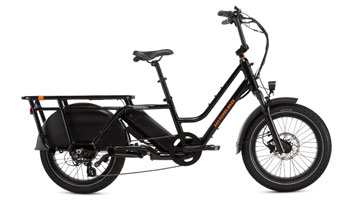
Payload: 375 lbs
Range: 60 miles
Top Speed: 28 mph
Tire Size: 3.3″
Weight: 86 lbs
Pros: Powerful, solid acceleration and hill-climbing
Cons: Long frame makes storage/transport more difficult, not a standout in off-road conditions
Cargo ebikes might be the greatest thing since sliced bread for city dwellers looking for a way to get around town and run errands without looking for parking. But what if your trip to the grocery store involves some off-road riding? Well, in that case, you might be interested in a fat tire cargo electric bike. While most cargo ebikes come with tires on the wider side to support heavier loads, not all cargo ebikes are created equally when it comes to off-road riding.
In naming a best overall fat tire cargo ebike, it was a tough call between the Radwagon 5 and our Best Overall Electric Cargo Bike, the Specialized Globe Haul LT. Both have mid-fat tires of 3.3″ and 3.5″, respectively, plenty of power, cargo space, and fun, useful extras. What gave the Radwagon 5 the edge for us is the Haul LT’s lack of a front suspension fork. No doubt, cargo ebikes are best suited to replacing cars in urban environments, but with the off-road focus in this article, which looks at fat tire ebikes in particular, the lack of front suspension was a major ding in our estimation for truly off-road conditions.
Neither bike will be a standout in off-road conditions due to the extra-long wheelbases, but if we were to choose a cargo bike for a grocery run or ride to school that involves some trail riding, it would be the Radwagon 5 thanks to the larger tires, front suspension, and powerful motor. To see how it stacks up to other cargo ebikes on the market, check out our Best Cargo Ebikes review.
CHECK PRICE ON RAD POWER BIKES
Photo: Matt Medendorp//The Inertia
Runner-Up Best Folding Fat Tire Ebike
Ride1Up Portola ($995)
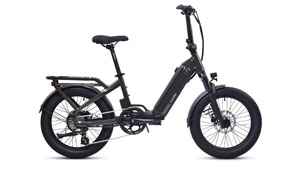
Payload: 300 lbs
Range: 20-40 miles, 25-45 miles with larger 13.4AH battery
Top Speed: 28 mph
Tire Size: 3″
Weight: 60 lbs
Pros: Powerful for its size, integrated rear rack can take a second passenger, great value
Cons: Smaller frame may feel a bit too compact for larger riders, not the fattest tires (3″)
The Ride1Up Portola stands out amongst the wide field of foldable fat tire ebikes thanks to its powerful internals, stylish looks, and extras like an integrated rear rack sturdy enough to support a second rider.
The bike only comes in one frame size, which will feel a little small for riders over six feet tall, but it is surprisingly light and easy to maneuver. The bike comes in two versions with two battery sizes. The 10.4AH battery version retails at $995 with a range of 20-40 miles, and the 13.4AH version of the bike retails at $1,195 with a 25-45 mile range. That’s a pretty short range, compared to most other ebikes on this list, and especially compared to the Lectric XP4, the Portola’s closest competitor, which has a stated range of 50 miles with its 10.4AH battery, and 85 miles with its long-range 17.5 AH battery.
The difference is in the motor, with the Portola having a bit more “oomph” under the hood for steep hill climbs and faster acceleration – that’s simply going to chew through the battery quicker, no matter how you slice it. Lectric’s XP4 also benefits from the newly introduced torque sensor, which gives a smoother, more intuitive power delivery and increased efficiency for longer range riding.
If you’re sitting here trying to decide between the Portola and the Lectric XP, you’re in good company. Our editors have spent hours scratching their heads here and have come up with this quick and easy comparison. If overall range is what you prioritize, choose the XP4. If you prefer to have a bit more power under the hood for hill-climbing and taking a second rider, the Portola will be the best choice for you (unless you choose to go with the upgraded XP4 750, which tacks on a 750-watt motor and larger battery for $300). One other consideration is rider height/size. The Portola feels a bit small for riders over six feet tall. Not terribly so, but if you’re still undecided and over 6′, we’d likely push you towards the XP4. Read our full review of the Ride1UP Portola here.
CHECK PRICE ON RIDE1UP
Photo: Will Sileo//The Inertia
Stylish and Foldable
Aventon Sinch 2.5 ($1,799)
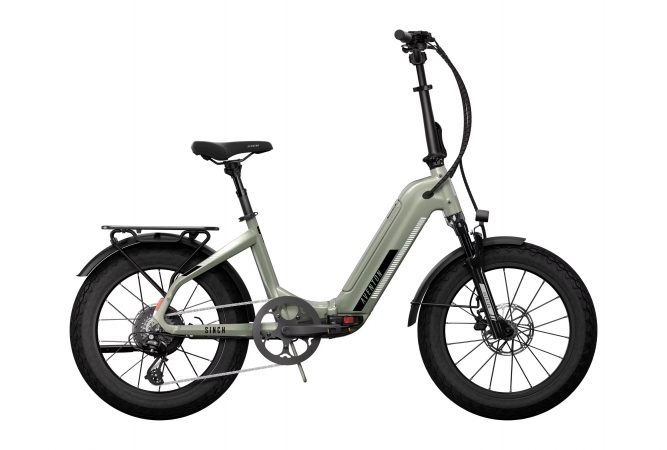
Payload: 300 lbs
Range: 55 miles
Top Speed: 25 mph
Tire Size: 4″
Weight: 68 lbs
Pros: Sleek design and premium feel for a great price
Cons: Expensive, lacks Aventon Control Unit with tracking, etc, on other new Aventon ebikes
The Aventon Sinch 2.5 packs a punch. The compact frame is good-looking, and the bike provides top-tier user-friendliness with a low step-through design, easy-to-understand controls, and a supremely comfortable and intuitive ride thanks to the front suspension and suspension seatpost, torque sensor, truly fat tires (4″), and hydraulic brakes. This is the bike that we’d recommend for those who are intimidated or skeptical of the whole “electric bike concept,” but at the same time, it’s a bike anyone can have fun with, or get some insane utility out of. In other words, the user-friendliness of this bike in no way impacts the bike’s overall performance.
As a folding ebike, the Sinch 2.5 packs down small for easy transport. It still weighs a decent bit, but it will fit in the back of a car, the corner of an apartment, or even in an RV, making this a great get-around vehicle for extended strike missions or road trips. The four-inch tires help there as well. One of our favorite and most memorable testing sessions on the Sinch.2 was a trip down to Southern California, where we used the Sinch to access more remote surf spots. Drive up to the trailhead, load up the bike with a surfboard and wetsuit, and get on the way. The four-inch tires were extremely welcome for this adventure, taking on soft sand with ease.
What kept this bike out of the running for a top spot is that, for the price, other folding bikes like the Velotric Fold 1 Plus or Lectric XP4 offer a better deal with slightly higher top speeds, and some extra features (in the case of the Fold 1 Plus). However, Aventon’s reputation for high-quality ebikes and the stylish good looks of this bike cannot be denied. With a step-through design, this is an approachable bike with top-tier components that those looking for a user-friendly ride should certainly take a second look at.
CHECK PRICE ON Aventon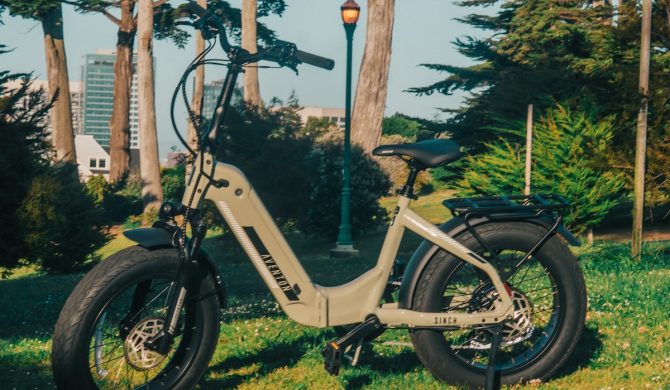
Photo: Skyler Fitzmaurice//The Inertia
Stylish and Powerful
Super73-R Adventure Series ($3,995)
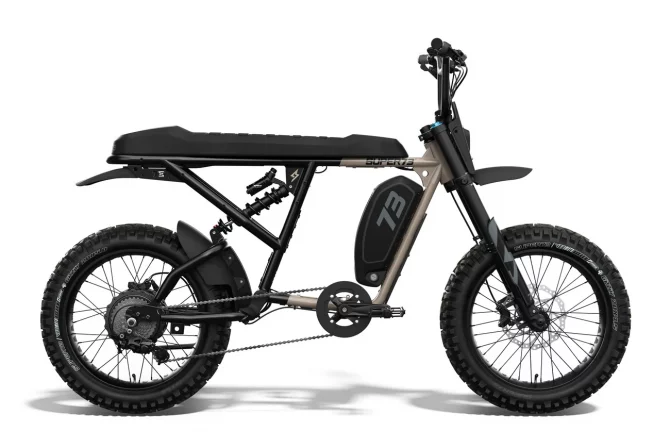
Payload: 325 lbs
Range: 40+ miles
Top Speed: 30+ unlocked
Tire Size: 4″
Weight: 73 lbs
Pros: Rugged e-moped looks, powerful motor
Cons: If you were hoping to pedal, this isn’t the bike for you
Super73 was one of the first to do the “electric moped” style of electric bike, and the Super73-R Series takes the “electric bike” concept and stretches it as far along the spectrum towards “electric motorcycle” as possible. With a powerful headlight, big tires, and moto-esque looks, this electric bike was made for stylin’, not pedalin’. The bike ships as a class 2, with throttle and pedal assist up to 20mph, but through the app, you can crank things up to class 3 (which will take you to 28mph on pedal assist only) or the “unlocked mode” which opens up the throttle and pedal assist to achieve speeds of 30+, but is only intended for off-road use.
A powerful motor provides smooth acceleration and the ability to take a second rider on the back of the extended (and quite comfortable) seat. Another huge plus is the highly accurate battery monitoring. Battery percentage levels aren’t always the most accurate on ebikes and tend to drop quickly as they reach the end of their charge, but not these bikes, which is a huge boon for a ride that, under no circumstances, do you want to find yourself pedaling home without electrical assistance.
However, we found the Super73-R lacking in a few features that elevated the Ride1Up Revv1 to our top-pick e-moped bike. For starters, the Revv1 is about $1,000 cheaper, and you end up with a lot more bang for your buck as well, with turning signals and a bit more oomph when it comes to acceleration. Furthermore, the screen on the Super73 is quite limited, so for additional ride-tracking, as well as swapping between classes/modes, you’ll need a smartphone with the Super73 app. And if you want to use the unlocked mode, you’ll need to activate it in the app whenever you turn the bike on (and it has a 5-minute automatic turn-off to preserve battery, which also triggers the need to re-activate off-road mode). That said, there are plenty of other options as well from Super73 that make great fat tire electric bikes for just about anything, both bikes that take the moto concept even further, and those that tone it down a bit. Check them out here.
CHECK PRICE ON Super73Full Suspension Folding Ebike
Heybike Tyson ($1,299)
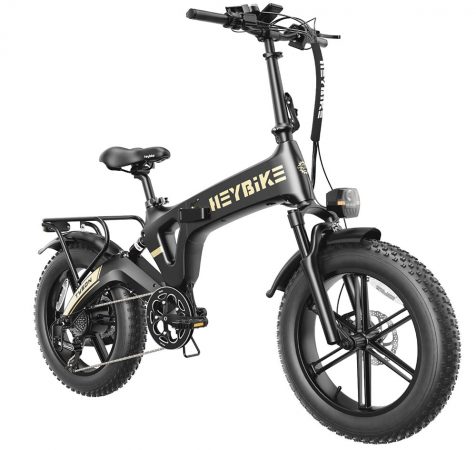
Payload: 400 lbs
Range: 55 miles
Top Speed: 28 mph
Tire Size: 4″
Weight: 77 lbs
Pros: Super-powerful, full-suspension folding electric bike
Cons: The bike is awkward to carry/move when folded up
The Heybike Tyson is a foldable, magnesium-alloy ebike that won Best of CES for 2023. Considering the stiff competition for this trade show of the latest and greatest tech, this is no small feat. With a sleek design and multiple color options, it’s an eye-catching yet practical ride that gets you where you need to go. The Tyson is perfect for tackling rough terrain with its rugged tires, hydraulic suspension, and 400-pound load limit, making it ideal for short trips, such as grocery runs or picking up kids from school.
Equipped with a 48V 15Ah battery, the Tyson boasts a 55-mile range with pedal assist, a top speed of 28 mph, and useful features like turn signals, a bright headlight, and a smartphone-compatible display. Some minor drawbacks include a slight lag in acceleration and slightly rickety plastic fenders. But compared to other bikes with similar specs, it’s a solid, dependable ride that is well worth the price of admission. Read the full review here.
CHECK PRICE ON HeybikeBest Fat Tire Cruiser
Murf Electric Bikes Alpha Murf ($2,595)
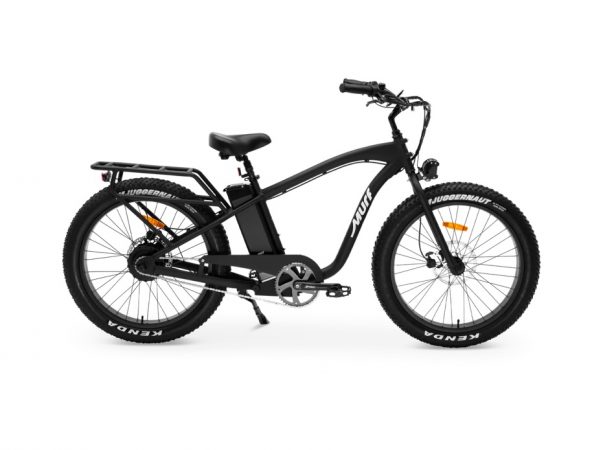
Payload: Not listed
Range: 30-50 miles
Top Speed: 28 mph
Tire Size: 4″
Weight: 70 lbs
Pros: Beach-cruiser style, with powerful electric bike components built for the beach
Cons: Pricey
Murf electric bikes have been making a name for themselves in the surf world. Specifically geared towards life by the ocean, the brand’s beach cruiser-inspired designs have become a common sighting on the trail down to Lower Trestles as well as other breaks up and down the California coast. While a bit pricier than other options on this list, with premium components and two years of full servicing and warranty, you can’t go wrong with a Murf if you’re located in Southern California, where Murf is based.
CHECK PRICE ON Murf
Fat tire ebikes are often equipped with extra power, perfect for the hilly streets of San Francisco. Photo: Skyler Fitzmaurice//The Inertia
Honorable Mentions
We’ve also tested the Heybike Brawn with an incredible 1400W peak-power motor for zippy acceleration. However, we found it to be very similar to the Lectric XP 2.0, and being a bit pricier, we gave the nod to the XP.
The Himiway Zebra is another fat tire ebike we’ve tested and were quite impressed with, boasting an 80-mile range on pedal assist. While no ebike will truly attain the full advertised range in real-world conditions, testing has proven the Zebra to be a true long-range ebike. However, the torque sensor on this bike wasn’t our favorite among all the models we tested.
The Heybike Mars 3.0 is another bike we’ve tested with awesome bang-for-buck value. However, with some ghost-pedaling at higher speeds, and extras on the Lectric XP 2.0 and Ride1UP Portola like an integrated rear rack, we opted to include these options over the Heybike Mars.
The Electric Bike Co. Model R rides the edge of what we’d consider to be a fat tire ebike. With 2.35-inch tires, it almost qualifies as such, and with an upright pedaling stance and swept-back handlebars, we found this bike to be better suited to city streets than off-road activities. It is also incredibly customizable, from colors to handlebar style, to add-ons like storage and racks, if you’re stoked on personalization.

All of the bikes in this review make use of a rear-hub motor. Photo: Will Sileo//The Inertia
Best Fat Tire Electric Bikes Comparison Table
| Model | Price | Range | Top Speed | Motor | Battery | Weight | Payload |
| Ride1UP Vorsa FT | $1,695 | 60 mi | 28 mph | 750 W | 15 Ah | 72 lbs | 440 lbs |
| Aventon Aventure 3 | $1,999 | 65 mi | 28 mph | 750 W | 733 Wh | 77 lbs | 400 lbs |
| Lectric XP4 | $999 | 65 mi, 85 w/ upgraded battery/ motor | 28 mph | 500 W, 1,000 peak or 750 W, 1,310 peak | 10.4 Ah or 17.5 Ah | 69 lbs | 330 lbs |
| Engwe L20 2.0 | $799 | 60 mi | 28 mph | 750 W | 13 Ah | 68 lbs | 265 lbs |
| Velotric Fold 1 Plus | $1,499 | 68 mi | 28 mph | 750 W | 13 Ah, 624 Wh | 63 lbs | 450 lbs |
| Engwe M20 3.0 | $1,999 | 90 mi | 28 mph+ | 3,300 W | 20 Ah, 60V | 102 lbs | 330 lbs |
| Velotric GoMad | $1,999 | 75 mi | 28 mph | 750 W (1,300 peak) | 48V 16.7Ah (801 Wh) | 78 lbs | 500 lbs |
| Ride1Up Revv1 | $2,395 | 30-60 mi | 28 mph+ | 1,000 W | 20 Ah | 93 lbs | 350 lbs |
| Radster Trail | $2,199 | 65 mi | 28 mph | 750 W | 15 Ah, 720 Wh | 77.5 lbs | 375 lbs |
| Radwagon 5 | $2,399 | 60+ | 28 mph | 750 W | 15 Ah | 86 lbs | 375 lbs |
| Lectric Xpeak 2.0 | $1,499 | 60 mi | 28 mph | 750 W, 1,310 peak | 15 Ah, 720 Wh | 67 lbs | 330 lbs |
| Ride1UP Portola | $995 | 20-40, 25-45 w/ 13.4AH battery | 28 mph | 750 W | 10.4 Ah or 13.4 Ah | 60 lbs | 300 lbs |
| Aventon Sinch 2.5 | $1,799 | 55 mi | 25 mph | 500 W, 1,056 peak | 14 Ah, 636 Wh | 68 lbs | 300 lbs |
| Super73-R | $3,995 | 40+ mi | 28 mph+ | 750 W, 1,200 peak | 20 Ah | 73 lbs | 325 lbs |
| Heybike Tyson | $1,499 | 55 mi | 28 mph | 750 W | 720 Wh | 77 lbs | 400 lbs |
| Murf Alpha Murf | $2,595 | 30-50 mi | 28 mph | 750 W | 20 Ah (52V) | 70 lbs | Not listed |

Getting out for a testing day in sunny San Francisco. Photo: Sam Schultz//The Inertia
How We Tested The Best Fat Tire Electric Bikes
As surfers and outdoor adventurers, we at The Inertia have been hip to the ebike trend long before the pandemic showed us just how useful such micro-mobility could be. As ebike adoption became more mainstream in the U.S. in 2020, we launched the first edition of this review, narrowly focused on fat tire ebikes for surfers, giving special consideration to extras like racks and super-fat tires and powerful motors designed to take on loose sand. In 2022, we expanded the scope of this review, taking a look at fat tire bikes overall, instead of just those intended for the beach.
Our lead testers for this review are Will Sileo and Steve Andrews. Will, based in San Francisco, has the perfect urban testing conditions to test out electric bikes. With plenty of hills, parks, and beaches to put the bikes’ range and power to the test (as well as the wilds of Marin and Pacific just a short drive away), it’s not hard for him to determine which bikes are worth including here in this guide, and which ones are not. He’s put in hundreds of miles on electric bikes over the years, and continues to pit the latest and greatest ebikes against each other in his testing environment.

Steve, putting the Radster Trail through her paces in British Columbia. Photo: Lindsay Gough//The Inertia
Steve, based in British Columbia, Canada, has his own ideal testing grounds – a mix of country roads and off-road riding conditions in and around Squamish, BC, as well as urban riding environments in the city of Vancouver. He’s put in hundreds of miles himself in testing these bikes.
Over the past three years, they have kept a close watch on the rapidly expanding ebike market, getting their hands on the latest and greatest fat-tire ebikes to hit the market. In our fall 2024 update, we added four new bikes and removed some discontinued models after extensive testing this summer. In our most recent update in the summer of 2026, we got our hands on the latest versions of a number of newly updated electric bikes and added them to the review, updating our rankings as needed. We tested all the ebikes here based on a set of criteria that will hopefully help you dial down your decision a bit better to find the perfect fat tire electric bike for you.
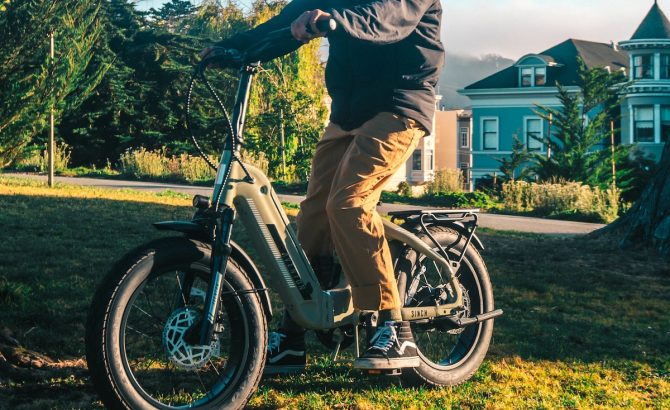
Stylin’ on the Aventon Sinch 2.5. Photo: Skyler Fitzmaurice//The Inertia
Testing Criteria
Speed: Not just top speed, but acceleration, especially up a hill, is important here. It’s not just about how fast it can go, but whether it can hold that speed. Lighter bikes with a larger motor will invariably be faster, so if speed is what you’re after, try for that combo. Newer ebikes, such as the Aventure 3, have a torque-sensing motor to help with smoother acceleration, but those won’t be as quick or easy to hit top speed as with a cadence-sensing ebike like the Ride1Up Portola.
Style: Yes, style points do matter in life, and these electric bikes are no exception. Sure, it’s based on opinion, but most of us know a good-looking bike from one that looks better under a paper bag.
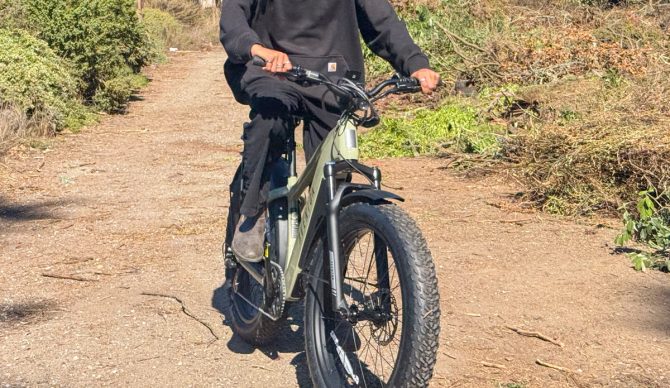
Fat tires and burly suspension make the Aventon Aventure 3 a beast on trails and varied terrain. Photo: Will Sileo//The Inertia
Components: We’re talking shifters, brakes, drivetrain, etc. If these aren’t held to a standard of high quality, the bike won’t work properly in the long term. Especially since electric bikes are generally much heavier than a standard pedal bike, having good components to withstand the extra wear is important. Here, we took into account what type of wheels, fork, and brakes can make the difference in an ebike being something that holds up over time or cause grief after just a few rides.
Battery: Does the battery hold a charge for long enough to be useful? Does it charge in a reasonable amount of time? These are important questions when thinking of the long-term regular use of an electric bike. Newer tech is coming out, such as in Rad’s intelligent battery on the Radster Trail, made to safeguard against spontaneous combustion, which is a positive step forward to addressing the safety concerns that, although infrequent, are certainly valid concerns.

An integrated rear rack on the Ride1UP Portola allows you to take a passenger. Photo: Will Sileo//The Inertia
Racks and Add-Ons: To be a proper adventure mobile, you need to be able to bring extra gear along for the ride. Beyond racks, some companies offer additional features that you can add to the kit, like integrated lights, passenger seats, baskets, and more, making it much more than just a bike to get from point A to point B. Our favorite here is an integrated rack, like those on the Ride1UP Portola and Lectric XP4, that allows for a second rider to hop on board.
Off-road: Since these are fat tire electric bikes, chances are you’ll want to take them off the pavement. So we took into account how well the electric bikes actually perform when the asphalt turns to gravel, dirt, or sand. If your main goal is to have a bike that will deal with sand, you’ll want to choose the fattest tires possible, and a strong motor, like the Lectric XPeak 2.0 or Aventon Aventure 3.

On your marks… Photo: Will Sileo//The Inertia
Fat Tire Electric Bike Buyer’s Guide
With so many options to choose from, finding the best fat tire electric bike for your needs may seem daunting. Fear not, as we have distilled the most important factors to consider when buying the ideal ebike for your needs.
Torque Sensor vs Cadence Sensor
How your electric bike senses rider input (aka pedaling) is one of the most impactful aspects/features of the electric bike experience. Torque sensors like that on the Aventon Aventure 3 deliver a more natural pedaling experience, applying power based on how much torque you’re applying to the pedals. Pedal harder, and more power gets delivered. Torque sensors feel more like riding a traditional bike, with a bit of extra oomph to back you up. Since they provide power based on how hard you pedal, they’re more efficient with their battery usage as well. However, some might find themselves preferring the easy-going and consistent power delivery of a cadence sensor.

Some ebikes offer a step-through model for shorter riders and easier mounting. Photo: Sam Schultz//The Inertia
Cadence sensors like those on the Engwe L20 2.0 and Ride1Up Portola are simpler, working off the speed at which you are pedaling. Basically, as long as the pedals are moving at a minimum cadence, the motor applies consistent power depending on the level of pedal assist that was chosen. The pros of this are that, as long as you are pedaling, you’ll get smooth, consistent power, regardless of how much effort you’re putting in. In fact, you’ll often find yourself pedaling with no effort at all, especially at higher pedal assist levels. On a Class 3 cadence-sensor ebike at full pedal assist, start pedaling, and the motor will kick in with full power until you reach the 28 mph speed limit of the bike. And unless the bike has a very wide range of gears, at that speed, you’ll likely find your pedaling does little to nothing at all except to keep the motor going.
This is less efficient than a torque sensor, but some might prefer the “effortless” feeling of a cadence sensor rather than the intuitive bike-assist feeling of a torque sensor. Thrill-seekers who want to achieve the highest speeds their bike can manage will likely be happier with a cadence sensor, while fitness enthusiasts and those who don’t want to deal with jumpy acceleration will likely prefer a torque sensor. In general, torque sensors are more expensive and tend to be reserved for more premium ebike models.

4″ fat tires on the Aventon Aventure.2 (left) compared to 3″ tires on the Ride1Up Portola (right). Photo: Will Sileo//The Inertia
Tires
Believe it or not, not all “fat tire” ebike tires are the same. For the purposes of this review, we only considered bikes with tires 3″ or wider. 3″ tires are fat enough to handle some offroad use, but where they truly shine is mixed terrain, with better handling and efficiency on paved roads than a 4″ fat tire, but still maintaining the ability to hit unpaved conditions now and again. For true offroad conditions – think sand, snow, and rocky uphill scrambles – 4″ tires (like those on the Aventure 3) are the way to go.
Battery
Life: The battery is the heart and soul of your electric bike. A quality battery not only ensures longevity but also reliable power when you need it. Check the battery’s voltage and Watt-hour ratings – higher values will give you more power and range.
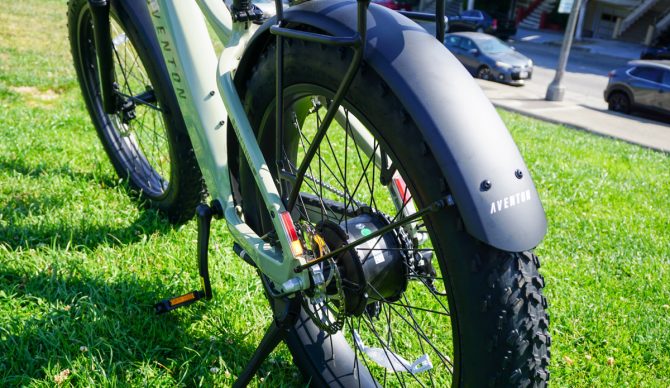
A large (usually black) cylinder on the rear wheel is a dead giveaway for a rear-hub motor. Photo: Will Sileo//The Inertia
Motor
Placement: Motor placement affects the bike’s balance and ride feel. Hub motors are common and provide good power, but mid-drive motors offer better balance and efficiency, especially in hilly terrain. All the bikes featured here offer a rear hub motor, which is the most common.
Power: Ebike motors are not created equally – some being more powerful than others. And with a few different ways to describe the power of a motor, it’s not always an apples-to-apples comparison. In general, the power of an ebike’s motor is expressed in Watts, typically falling within the range of 500W-1000W. The “sustained” power of the motor, aka the output it can maintain over an extended period of time, is the most commonly listed number.
Some bikes also list their “peak” power, the power they can achieve for quick bursts, say, to help you get up a hill. Another metric of motor power is how many Newton-meters (Nm) of torque the bike can put out. This number speaks less to how fast the motor can run, and more so to how much grunt it’s got under the hood for heavy loads, etc.
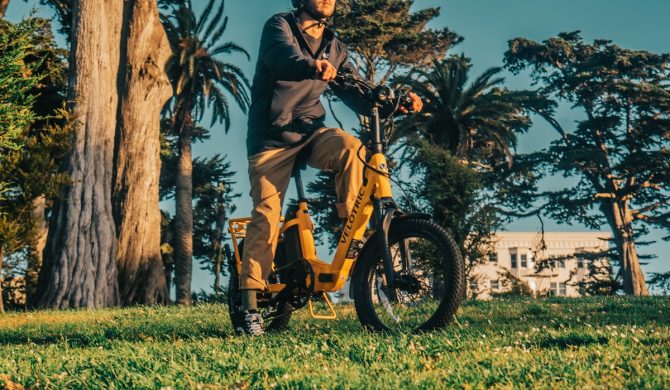
The Velotric Fold 1 Plus has oodles of power, at the cost of some range. Photo: Skyler Fitzmaurice//The Inertia
Range
Consider how far you plan to travel on a single charge. Ebike ranges can vary greatly, so choose a bike that exceeds your typical ride distance, keeping in mind that factors like terrain and rider weight can impact the actual range. Riding at higher speeds will chew through battery life faster than riding at lower pedal assist levels. Torque sensors are also more efficient than their cadence sensor counterparts. Some bikes allow you to add on a second battery, like on the RadRunner series, vastly extending the range of the ebike.

The Radster Trail has one of the nicest displays we’ve tested, with lots of fun extras like RFID locking. Photo: Will Sileo//The Inertia
Ease of Use
Ensure the bike’s controls are user-friendly, and it’s easy to monitor battery life, switch power modes, and manage other functionalities. We were big fans of the menu and display on the Radster Trail.
Weight
Fat tire electric bikes are usually heavier than what people are used to, especially if it’s your first ebike. Larger, moped-style bikes such as the Revv1 weigh over 90 lbs, while smaller bikes such as the Ride1UP Portola are closer to 50 lbs. Make sure you can handle the weight, especially if you’ll be carrying it upstairs or storing it in elevated places.

Make sure your bike is sized properly. Riders more than 6′ tall may feel more comfortable on a full-frame electric bike. Photo: Will Sileo//The Inertia
Riding Comfort
When first riding the ebike, sit down, put your hands on the handlebars, and really give it a feel. Pay attention to the seat, handlebar height, and the overall riding experience. Ideally, you’ll be riding for long periods at a time, so any small annoyance will only grow with time on the bike. If you plan on going off-road, extras like suspension will make a huge difference in the long run for a comfortable ride.
This is a huge differentiator in a lower-priced ebike vs. more premium models like our top pick, the Radster Trail, with higher-quality components and front suspension. Another thing to pay attention to in the riding comfort department is the bike’s size – some bikes offer multiple frame sizes for larger and smaller riders.
Warranty and Support
A solid warranty and accessible customer support signify the manufacturer’s confidence in their ebike and their commitment to your satisfaction. American companies such as Lectric and The Electric Bike Co. seem to have a bit more invested in customer service, knowing that a bit of friendly service can make all the difference.
Assembly is another thing to pay attention to. How will your ebike arrive? Will it come pre-built and ready to ride, or will you need to do some assembly yourself? Are there instructions, or will you be searching YouTube for a backyard assembly video? Ebike manufacturers like Aventon and Lectric are leaders in the instructions-game, with helpful videos produced by the brand, detailed instructions, and all the tools you need to get your bike ready to ride.

Integrated rear racks are welded to the bike’s frame, providing a stable platform for a second rider to hop on. Photo: Sam Schultz//The Inertia
Accessories
Don’t overlook the availability and compatibility of accessories like fenders, racks, and lights, which add functionality and safety to your rides. We found Lectric to have a wide range of options for good value. Electric Bike Co takes it a step further and allows you to customize the bike from the ground up.
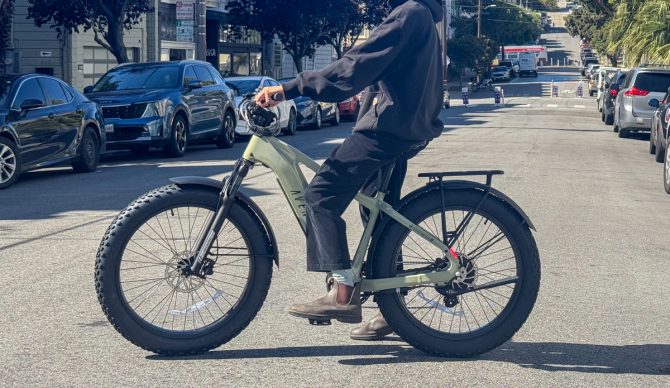
When it comes to fat tire ebikes, the Aventon Aventure 3 is certainly a looker. Photo: Will Sileo//The Inertia
Style
Do you want to hide the fact that you’re riding an electric bike or shout it from the rooftops? Some traditional-styled electric bikes hardly look like an electric bike at all, until you start gliding uphill, that is. Scrambler-style electric bikes harken back to the 1960s era of motorcycles, and despite the electric motor (and pedals), ebikes like the Revv1 and Super73-R are often more motorcycle than they are bike. Heavy, but with a powerful motor, these are sure to turn heads.

Style is always important, especially when you’re taking the plunge on an electric bike. Photo: Will Sileo//The Inertia
Classification
There are three classifications for electric bikes. As with any fun new invention, regulation varies state by state, so be sure to check local laws to make sure your electric bike is compliant where you live.
Class 1 electric bikes go up to 20 mph on pedal assist only, meaning they don’t have a throttle, and can be taken anywhere you can ride a regular, non-electric bicycle. None of the bikes we feature here are exclusively Class 1; however, some give you the option to implement it for areas where Classes 2 and 3 aren’t allowed.

The RadRunner 3+ tops out at Class 2 while the RadWagon 5 is a Class 3 ebike. Photo: Will Sileo//The Inertia
Class 2 also tops out at 20 mph, but with a throttle. You can take a Class 2 electric bike almost anywhere you can take a Class 1, but are often restricted from single-track mountain bike trails due to the damage the instant torque of a throttle can produce.
Class 3 is a bit confusing, considered to top out at 28 mph, but on pedal assist only, with the throttle only taking you up to 20mph. These are often only allowed on roads and are restricted from bike trails and multi-use pathways. Bikes that can be configured to class 3 include the Radster Trail, Lectric Xpeak 2.0, XP4, and Aventon Aventure 3.
Some electric bikes can reach speeds even higher than 28 mph, often accessed by a specific mode on the bike, which is only supposed to be used on private land, as a sort of honor system, although we’re sure the temptation to whiz around town at high speed is hard to ignore for most. Bikes on this list with an “unlocked mode” for high-powered riding include the Ride1UP Revv1 and Super73-R.

Folding ebikes are great for packability and storage. Photo: Steve Andrews//The Inertia
Caring For Your Electric Bike
For most of us, shelling out hard-earned money for an electric bike isn’t taken lightly. So the best way to ensure that the purchase is a smart one is to make sure you’re taking care of your investment. Nothing is too difficult, but there are a few pointers we’d like to share to help ensure your electric bike has a long and healthy life, and that your relationship to your bike is one of mutual respect.
Comfortable Storage: Treat your electric bike to a safe haven away from the elements, ideally indoors or under a protective cover. This will keep it snug and protected from rain, snow, and harsh sunlight, preserving its good looks and performance.
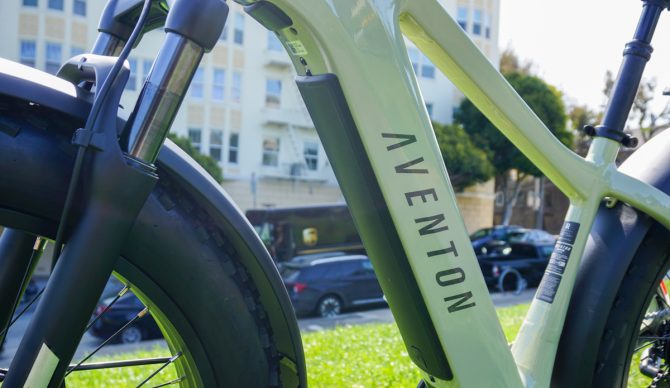
Rated to IPX6, the Aventure 3’s battery can withstand splashes and riding in the rain without worry. Photo: Will Sileo//The Inertia
Battery Care: Ensure your battery leads a long and happy life by charging it regularly and avoiding extreme temperatures. Remember to unplug it once it’s fully charged and store it separately if you won’t be using your electric bike for an extended period.
Keep it Clean: Give your electric bike a gentle wipe down with a soft cloth, removing dirt and grime without scratching its surface. Pay special attention to the electrical components, keeping them clean and dry for optimal functionality.
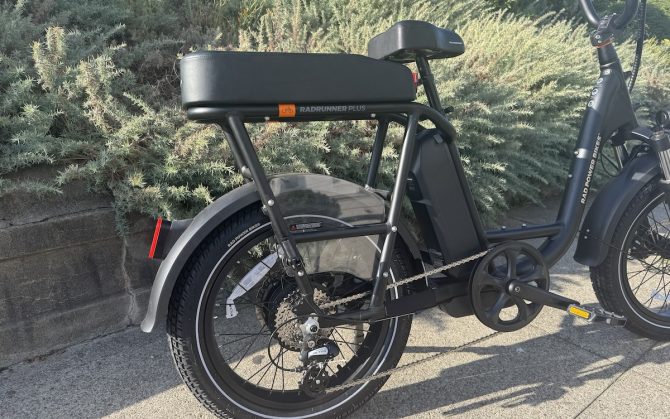
The RadRunner Plus comes with a passenger package included. Photo: Will Sileo//The Inertia
Chain TLC: Show your electric bike’s chain some love by lubricating it regularly and ensuring it’s properly tensioned. This will keep it running smoothly and prevent any unexpected hiccups during your ride.
Brake Check: Since electric bikes usually weigh significantly more than standard bikes, their brakes have to work much harder to stop quickly. As such, they tend to wear out faster. Make sure your brakes are always in tip-top shape, adjusting them as needed and replacing worn pads or cables. This way, you can trust your ebike to stop on a dime when things get hectic out there.
Good Tires: Keep your tires inflated to the recommended pressure and check them for wear and tear. This will not only provide you with a smoother ride but also reduce the risk of punctures or other issues that could leave you stranded.
Regular Checkups: Just like any dependable sidekick, your electric bike deserves regular check-ins. Perform routine inspections and maintenance to keep it running at its best, addressing any issues before they become major problems.

Treat your bike well, and it will take you to some pretty awesome places. Photo: Will Sileo//The Inertia
Editor’s Note: To see more ebike options, check out our guides to The Best Folding Electric Bikes and The Best Cargo Electric Bikes. Looking to trick out your ride? Here’s our guide to The Best Ebike Accessories. For more ebike reviews and features on The Inertia, click here.
Return To: Comparison Table | Buyer’s Guide | Top Picks

The Best Surfboard Bike Racks


