
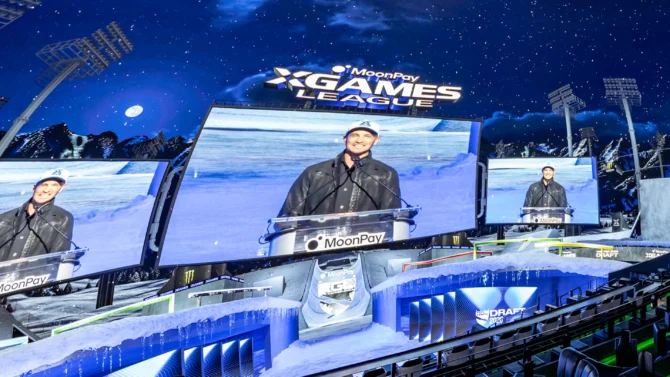
X Games CEO Jeremy Bloom delivered opening remarks before the draft went down. Photo: HelloAtlasMedia

Skiing and snowboarding have officially become a team sport. On Wednesday, the X Games League held its inaugural winter draft, in which skiers and snowboarders from around the world were selected to compete on teams in an experimental new format.
The winter edition is a follow-up to the X Games League’s summer season, which concluded in July. Like in the summer, teams of athletes will earn points based on individual contest results. Then, at the end of the season, the team with the highest points total is crowned champions and takes home a cash prize.
In total, 100 athletes were approved for draft eligibility, vying for 40 spots across four teams. Those teams were: XC New York, headed by GM Dave Sypniewski; San Francisco Bay Area-based XC Golden State, helmed by GM Johnny Moseley; XC Park City, led by Sharalee Hazen; and the Canadian team XC Whistler, captained by GM Ryan Stutt.
The event, held at Cosm, an extended reality entertainment venue in Los Angeles, was modeled after drafts in more traditional team sports. Athletes and onlookers arrived at a red carpet, followed by a live televised event in which GMs and owners huddled around laptops to select athletes, who then stepped up to pose with a jersey (though not everyone made the trip out, like first-round pick Eileen Gu, who accepted her conscription to XC Golden State via pre-recorded message). By the end of it, the teams were locked in, hopes were realized and dreams crushed, and the winter season was officially underway.
Afterwards, we talked to all four general managers to get their perspectives on what it takes to make a winning team.
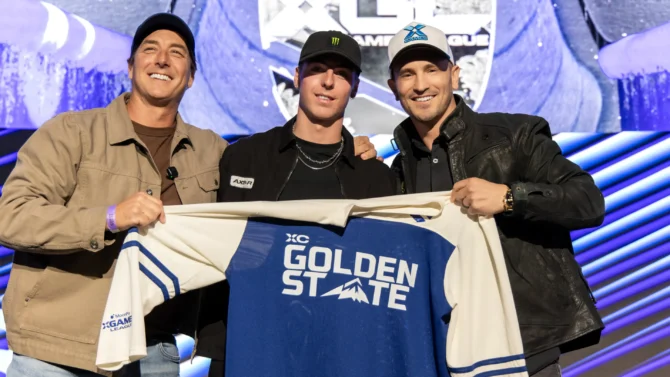
Skier Luca Harrington (center) with XC Golden State GM Johnny Moseley (left) and X Games CEO Jeremy Bloom (Right) Photo: Jen Rosenstein
The right mix of athletic skills
Creating a winning team requires a certain amount of alchemy, but there is an analytical side to selections. “I was trying to take a look at what these athletes are capable of to this point, what they’ve done in the last couple of years,” said XC Golden State GM Johnny Moseley of his decision-making process for the draft. “Ultimately, we need to score points.”
“Multidiscipline was big,” said XC Whistler GM Ryan Stutt. “It’s just a points multiplier. Also getting high-ranking athletes as early as you can is also a factor. You only have a limited amount of events.”
XC New York GM Dave Sypniewski also took into consideration the ratio of young talent to reliable veterans. “There’s a lot to be said about getting youthful talent who are going to grow, but this is year zero of the league, so you have to have known entities that people want to tune in and see,” he said. “You can’t just go, ‘I’m gonna pick all the young people, and in two years I’m gonna be the best.’ We all have to build this together now.”
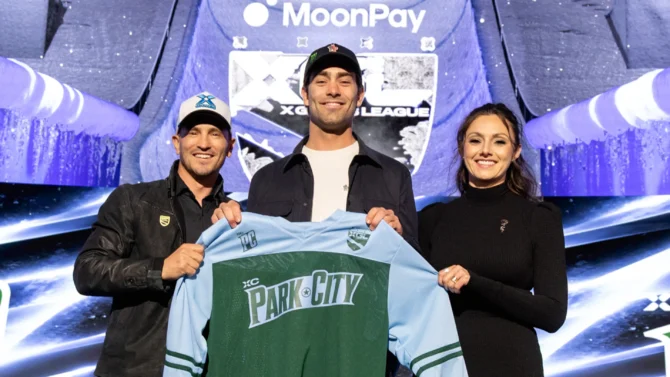
Skier Alex Hall (center) with XC Park City Sharalee Hazen (right) and X Games CEO Jeremy Bloom (Left) Photo: Jen Rosenstein
Representing their home city
While the atheletes themselves hail from around the world, each organization is centered around a specific city. This meant that each GM also had to find ways to make sure fans were able to identify with their home team. “It’s important to have people from Park City,” said XC Park City GM Sharalee Hazen. “It’s easy in the draft to all of a sudden, go, ‘Oh my gosh, we don’t have a hometown hero.’”
As the only team not based out of the United States, Stutt also bore the burden of proving Whistler’s international bonafides. “We’re an international club,” he said. “We need to represent Canada, so about half the team is Canadian. Which is what we wanted.”
Finally, Sypniewski also considered the fact that his team had to be a cultural fit for its home city, especially in a place with as unique and recognizable a culture as New York. “We want to have a New York brand,” he added. “New York has a certain attitude and fast-paced life about it. So it’s like, ‘How do you fit in with that?’ Not that you have to be that person, but are you comfortable with it?”
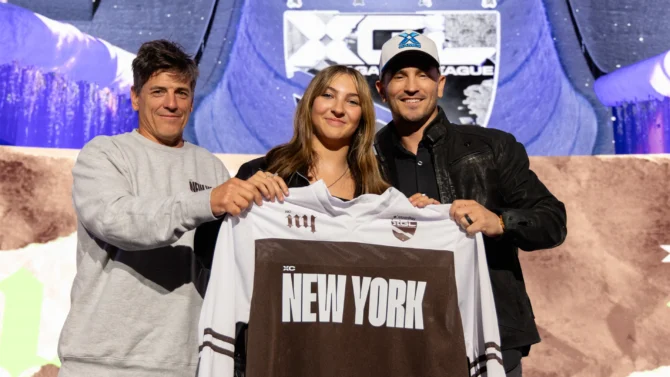
Snowboarder Jessica Perlmutter (center) with New York GM Dave Sypniewski (left) and X Games CEO Jeremy Bloom (right) Photo: Jen Rosenstein
Bringing athletes together as a team
Then, there’s perhaps the greatest challenge of all: figuring out how to take a group of athletes from a traditionally individual sport and get them to work together. “The biggest challenge is forming a team bond early on,” explained Hazen, who was able to use lessons learned as the GM for Los Angeles in XGL’s summer league. “The strategy we used with the Californians was we did a road trip before going to Sacramento. So by the time we hit the first contest, the majority of the team was really bonded.”
This time around would be even more challenging, on account of the far-flung international locales of the Park City athletes, “So I think we’re going to have to look more on regions to build those individuals together,” she added. “Then when the contest happens, we just have to do a fair amount of team bonding off the slope.”
Sypniewski and team New York developed their own lexicon for finding athletes they thought would gel together once drafted. “We called it the airport test,” he explained. “If we were stuck in the airport for four hours with them, would it be chill? Can you hang out with the other athletes? Will fans want to be around you? Are you going to have the personality that if someone comes up to you, you’re going to be polite and nice to treat everyone with respect? I’m pretty confident that we have that.”
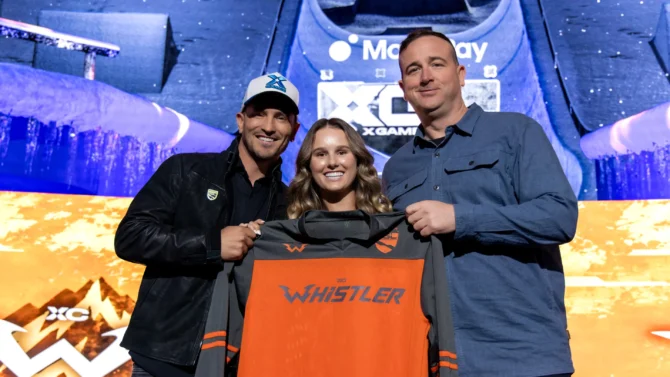
Skier Megan Oldham with XC Whistler GM Ryan Stutt (right) and X Games CEO Jeremy Bloom (left) Photo: Jen Rosenstein
Looking to the future
However, the draft is only the beginning. Now that they have their teams locked in, each GM had their eyes firmly on the horizon. “One of the questions I’m always asking myself about this team is ‘How can I add value to their performance?’” said Moseley. “A lot of them already have great support systems: the US Ski Team, Monster, Red Bull, and they’ve got their national teams. So, how can we augment that? Obviously, the X Games is helping by paying them, so that helps, but where can we also fill in and provide training camps and programming and stuff like that in between.”
“I believe that there’s this opportunity to take what everyone does as their sport and add a level of interest to it,” said Sypniewski. “It’s not changing the sport, what we’re changing is that we can take this group of individuals, but we’re going to have a support system and we’re going to work together in a way we haven’t done in a competition before.”
The first stop of the XGL Winter Season is Buttermilk at Aspen, Colorado on January 29-31. A month later, the league will convene in Calgary, Alberta, from February 19-21, then the season championship will take place in Ruka, Finland, from April 9-11.

