
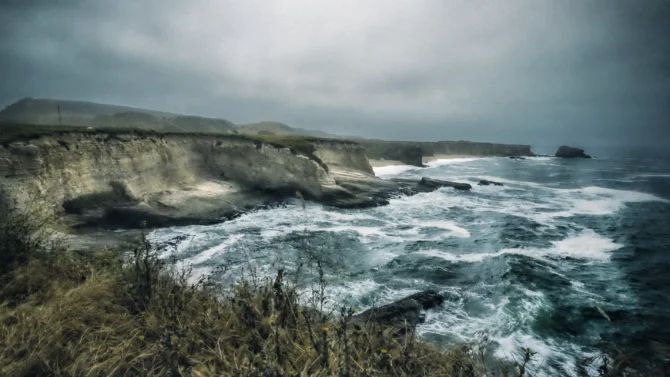
Big Sur under stormy skies that will likely be a familiar sight this winter. Photo: Unsplash

El Niño events can be good for surfers. It’s pretty simple: bigger storms make bigger waves. But good waves are just a silver lining to a climate pattern that can be very, very destructive. This year’s so-called “Super El Niño” is already breaking records, and the waves have come with it. But it’s not just surfable waves a powerful El Niño makes — it’s Kelvin waves, too. And those pack a real wallop. A planetary sized wallop.
Kelvin waves, for those unaquainted, are basically a sort of pulse of warm water that moves east along the equator or along a coastline. In this case, we’re talking about California’s coastline, because this year’s enormous El Niño is likely to send one there. You can’t see a Kelvin wave. If you think of it like a bathtub, it’s easier to understand. If your tub is full of cold water and you had a bucket of hot water, then slosh back and forth, the warm water doesn’t immediately mix. There will be pockets of colder water and pockets of warmer water, and on an oceanic scale, those pockets are absolutely huge. El Niño events like the one we’re currently in are affected by those deep pockets of warm water sloshing back towards the Americas from the tropics.
It makes the shallower, warmer waters that generally sit on top of the ocean’s surface much deeper, which in turn affects the cold water upwelling. That adds more energy to building storms, which is part of the reason why we can expect such violence from nature in the coming months. Since warmer water expands, it takes up more room. Which means, of course, an increase in sea level rise. Not because there’s more water, but simply because the molecules that make up the water are vibrating faster and pushing each other slightly farther apart. On a massive scale like the ocean, that could mean more sea level rise for the coast of California — which would have an outsized effect.
Already officials in California are preparing for what this winter might bring. A state of emergency has been declared to free up funds for recovery efforts.
According to reports, a kelvin wave recently hit the northern tip of South America in late August and could reach the shores of California in the coming days, which would greatly impact sea levels, raising them nearly a foot for months at a time as El Nino lingers.
We’re not being alarmists here. Kelvin waves have been happening for thousands of years, it’s just that now they’re adding on to a series of events that have pummeled the California coast of late: we recently saw big hurricane swells cause serious erosion. Kelvin waves are just another concern for the West Coast during what looks to be an extremely abnormal year.

