
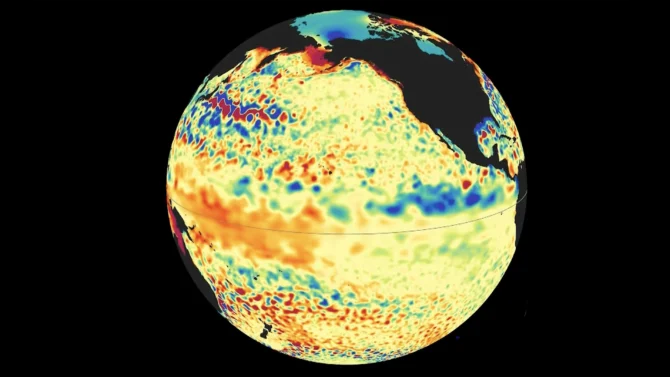
It’s going to be a wild winter for California, and a state of emergency has been declared. Image: NOAA//KTLA

On Monday morning, California’s governor Gavin Newsom announced that he was declaring a state of emergency in the days before what’s predicted to be the most powerful El Niño ever recorded.
“The emerging El Niño event is already breaking records, and forecasters expect it to continue to strengthen, potentially becoming the strongest in recorded history,” reads a statement from the Governor’s office. “Today’s emergency proclamation streamlines measures to help California prepare for this historic event.”
With state of emergency declared, states can now begin to prepare for what the future most likely holds. El Niño years bring unseasonably warm, wild, and wet weather to the West Coast, and with the current pattern as strong as it is, government agencies are warning the population to batten down the hatches.
“Among the actions ordered, the emergency proclamation directs state agencies to lead the state’s flood-risk-reduction efforts, stage flood-fighting supplies such as sandbags and pumps, and pre-position other critical equipment,” the governor’s office explained. “Caltrans will stage traffic-control, road-closure, and snow-removal equipment along the highways most at risk. The proclamation also prepares the California National Guard to support flood response, search-and-rescue, engineering, and logistics missions when needed. State environmental and natural resources agencies will support local efforts to prepare for flooding, landslides, and debris flows, by fast-tracking permitting and identifying other ways to cut red tape.”
Preparation is key in situations like this and, when properly implemented, can save lives.
“By planning early and coordinating resources ahead of El Niño, we are working to ensure communities and first responders have the personnel, equipment, and support they need to prepare for severe weather, respond quickly when conditions change, and protect lives and property across California,” California Office of Emergency Services Director Caroline Thomas Jacobs said.
Under normal conditions — years that don’t see El Niño or La Niña — the trades blow along the equator from east to west. That pushes warmer water from South America towards Asia. Colder, deeper water moves in to replace it, cooling sea surface temperatures and with them, calming the energy of potential storms.
But in an El Niño year, those trade winds slow down, and that warm water is pushed back towards the U.S. West Coast.
“The warmer waters cause the Pacific jet stream to move south of its neutral position. With this shift, areas in the northern U.S. and Canada are dryer and warmer than usual,” NOAA officials said. “But in the U.S. Gulf Coast and Southeast, these periods are wetter than usual and have increased flooding.”
For Newsom’s part, he believes that California can come out of this year’s predicted chaos.
“That is what this action is about,” he said. “Giving communities the support they need, giving first responders the tools to do their jobs, and giving families the confidence that their state is ready,” he said. “We are preparing for this El Niño early because every Californian deserves to be safe in their home, connected to their community and protected when severe weather comes.”

